Hansi Platzgummer
Artists from the Schnalstal
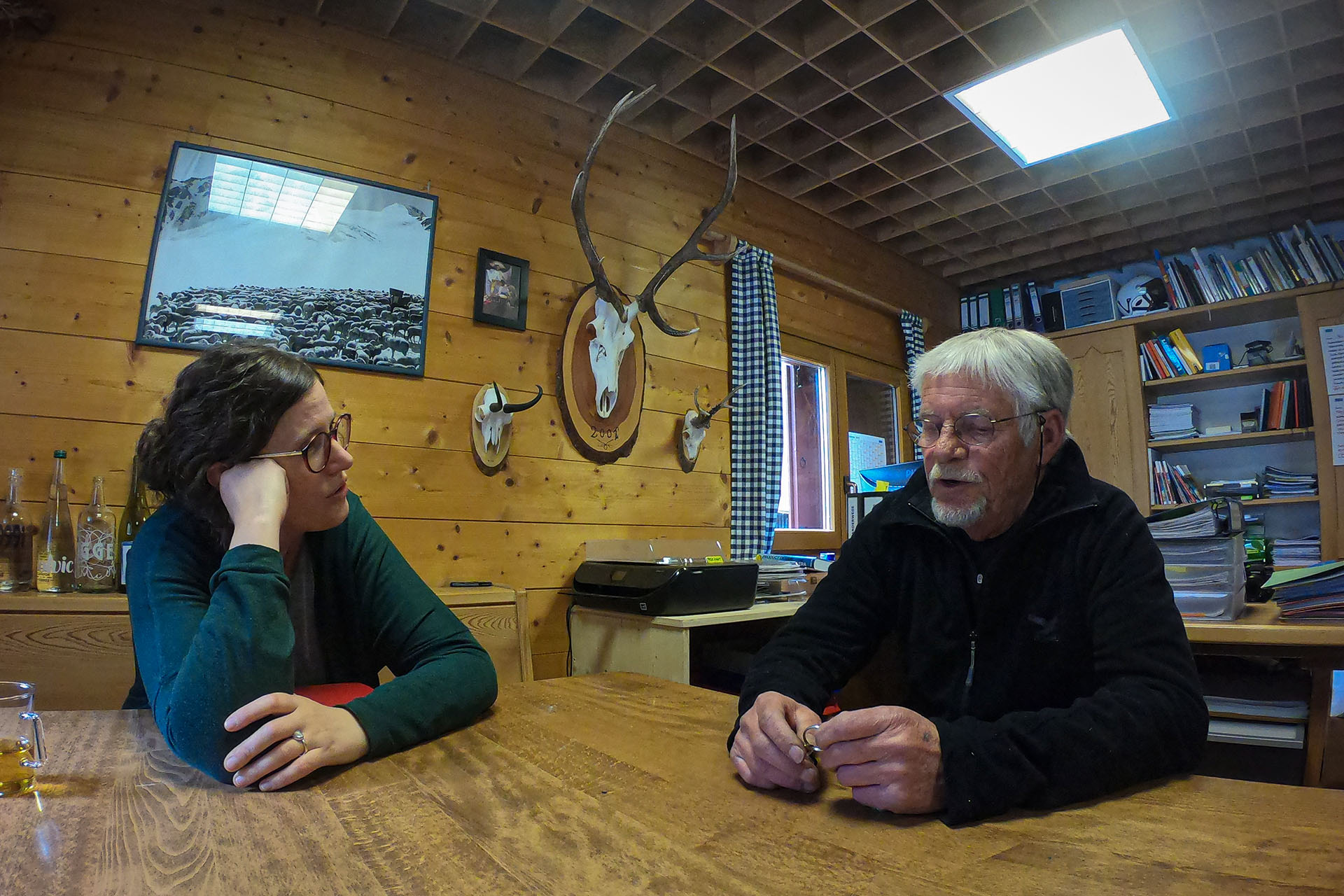
“It’s always there, the Similaun.”
Hansi Platzgummer on the mountain that has shaped his life and his art
Hansi Platzgummer, born in 1952, is – like his brother Sepp – a Schnalser native, his whole life closely interwoven with the Similaun, nature, the mysticism of the valley. This connection is also reflected in his pictures. In the following conversation, he provides insights into his career as an artist – and into his extensive knowledge of the (natural) historical development of the Schnalstal.
You have been working as a painter for many years. How did you get into art and what role did the Schnalstal and in particular the Similaun play in it?
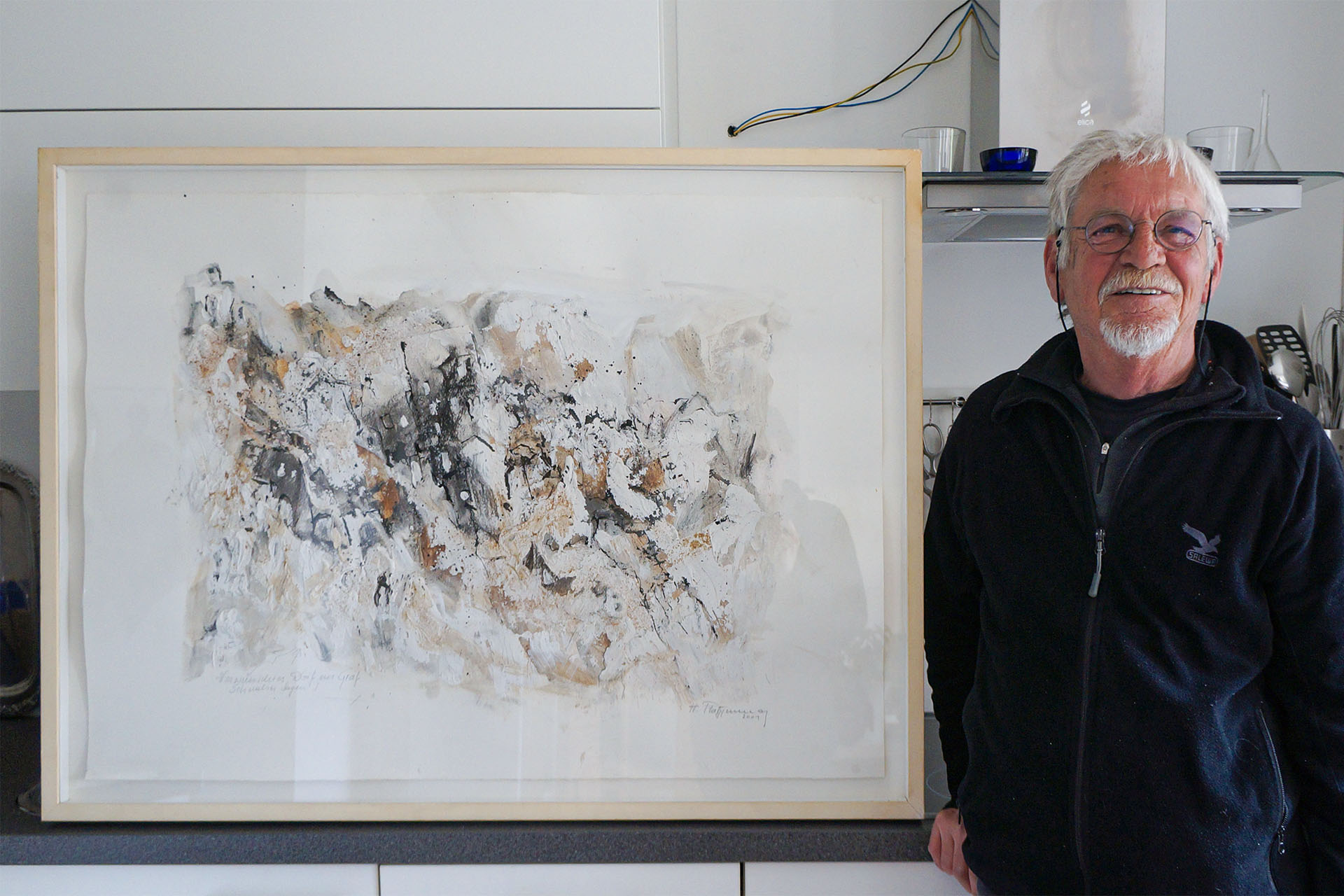
Yes, the art thing just happened that way… I’ve always drawn, but I’ve only really been working intensively with it in the last few years. I started with watercolor painting, with drawing the farms in the valley as they nestle into the landscape, harmonious and proud at the same time. At some point I started working with natural pigments and earths. In nature, these beautiful, gray-blue, ochre or reddish earths and clays are created through a variety of processes. I work with them and make pigments from them, which I then process with water using a kind of fresco technique to create structural images that appear somewhat abstract. So what does abstract mean – I couldn’t be any closer to nature than with these pigments. (laughs)
What also continues to fascinate me – in art and in life – are sheep and how they shape our landscape and the people in the Schnalstal. They often appear in my pictures. Without the sheep, the Schnalstal would not exist in its current form; the landscape has developed like this over thousands of years, influenced by the grazing of the animals. I am convinced that humans followed sheep and not the other way around. Sheep are excellent trailblazers, they find a way through everywhere. And of course they were the most important source of livelihood for the Schnalser population for a long time, both in terms of food and economy. I believe that the sheep’s paths are the valley’s original paths. If you follow these paths, you will also find the oldest traces of humans – cup stones, burnt offering sites, etc. “Ötzi”, the famous glacier mummy, also walked these paths. I always find inspiration for my art on these paths.
Since you mentioned Ötzi: As a child and later as an adult, you spent a lot of time at the Similaun Hut, which has been in your family for over 100 years and is on the way to the site where the Iceman was found. How did you experience this historic discovery?
The Similaun Hut was, so to speak, my second home, yes, that’s where the adventures of my childhood took place. When Ötzi was found, it was no big deal at first. They thought he was a missing mountaineer, so the body was recovered and the site secured. I remember my nephew calling me that day from the Similaun Hut and saying: ‘That’s a strange mountaineer, I’ve never seen one like him before, he’s got hay in his shoes and a really strange ice pick!’ (laughs) It was only later that the significance of the find became clear – and then, of course, many scientists from all areas came to the hut: archaeologists, botanists, geologists, but also matriarchy and myth researchers. I was out and about with many of them, which was very interesting and gave me a lot of knowledge. The area was being investigated from every conceivable perspective. I got to know the Schnalstal Valley and its mountains from a completely new perspective.
What connection do matriarchy and mythology researchers have to the Similaun?
We now know that the name Similaun goes back to the pre-Indo-Germanic name Sam Alu Ana, which means something like ‘White Goddess Ana’. Ana stands for earth mother. In the imagination of the mountain peoples, most mountains were originally female; with their springs and pastures they were considered to be life givers, hence the female names. It is assumed that in the Neolithic period matriarchy was the predominant form of society in Central Europe – patriarchy and male naming only prevailed later. If you look at the location of the Similaun, it is a very special mountain. Especially as a geographical orientation aid: coming from Juval, you have the Similaun in front of you, the same from Vent, and also from the Passeier Valley or from the Taschljöchl in Vinschgau – it is always there, the Similaun. This is also the reason why it appears in many legends, for example ‘The Three Blessed Ones’.
The great importance of our mountain world is evident in numerous places. In addition to Ötzi, other discoveries have been made that are almost as interesting and important: In the Finailgrube at 2,400 m, for example, there was a burnt offering site. Animal bones were found in its coal layers, but also glass beads from the Mediterranean region and amber from the Baltic Sea. The layers date back to the Bronze Age, i.e. to around 1,800 BC. This means that these passes and high pastures were already used as a connection from the Baltic Sea down to the Mediterranean.
Today, many people climb, ski and cross the mountain. This was also made possible by the glacier railway. How do you see the tourist development of the Schnalstal and the development that the valley has experienced as a result?
To change something, you always need people with ideas, plans and the strength to implement them. The glacier railway was an important development for the valley, even if a lot of things have changed as a result.
Mountain climbing used to mean venturing into nature. Nowadays, mountain climbing is more associated with “action”. Many people start in the valley, go to the summit and back again in a single day. What counts today is the altitude and the distances, it is divided into precise stages, time limits are set, etc. It is almost a competition. Many people no longer really experience nature because they have to take their time for it – and time is in short supply these days. But maybe that’s just the talk of an old man! (laughs)
Nature simply does not move quickly. But if you let yourself be drawn into it, there are so many amazing things in store – especially in the mountains, especially here in the Schnalstal, with its originality. And you can still experience that today, despite all the changes.