

The sheep transhumance
The sheep transhumance
The sheep herding between Schnalstal and Ötztal, a cultural heritage that is still alive today.
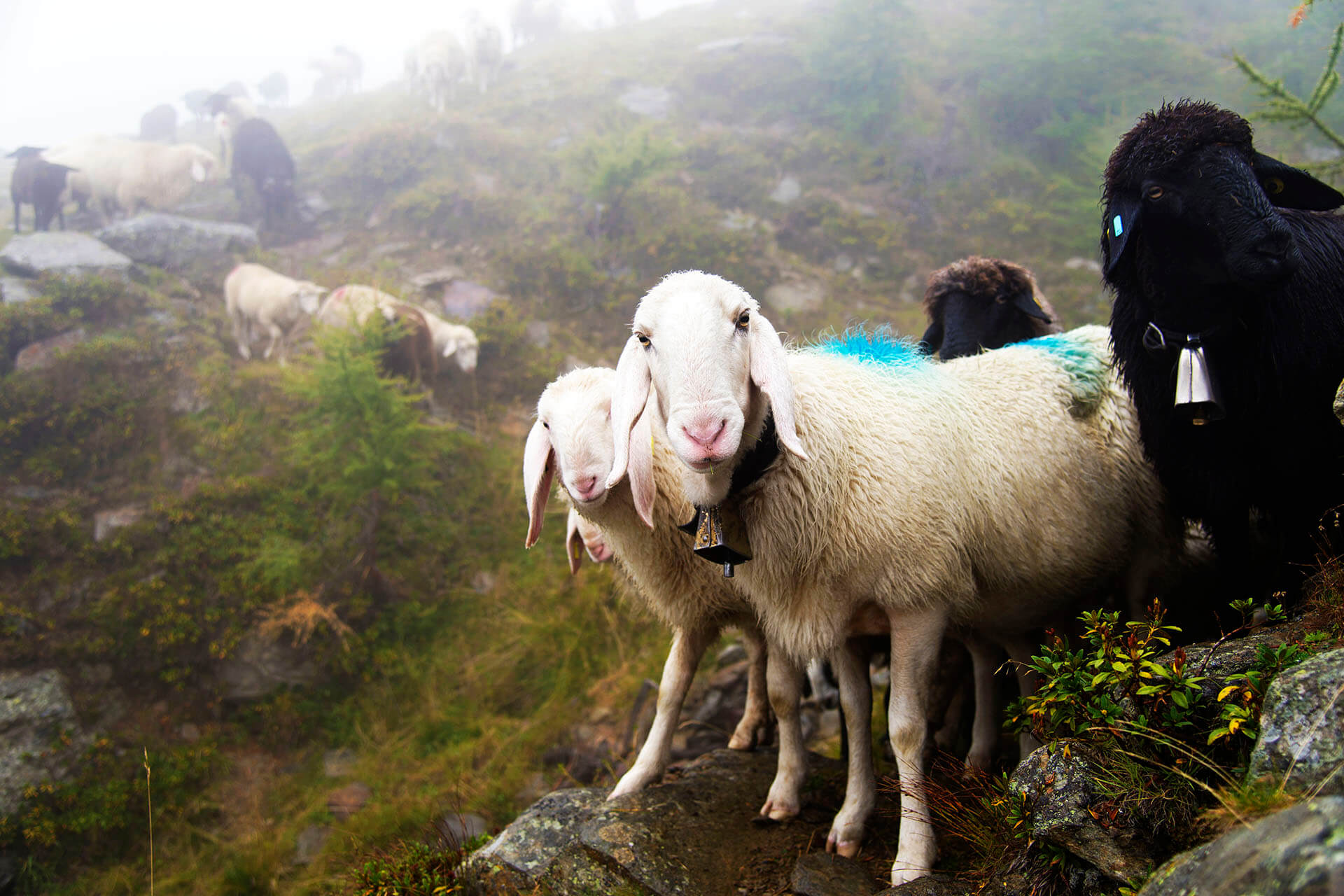
A living legacy of Alpine culture
Transhumance – a seemingly foreign word. It hovers over the Schnalstal Valley like a gentle whisper. It tells of lively flocks of sheep, of sedentariness and high-altitude pastures between the Ötztal Alps. Of 2-day marches over 44 kilometres. And of a tradition that points deep into the valley’s prehistory.
Discover the history of transhumance
Go on an exciting journey of discovery led by Gianni Bodini, who has researched the history of transhumance for you from its beginnings to the present day.
The tradition of transhumance
In the Schnalstal Valley, as in the Vinschgau Valley, the sheep remain in the care of their owners during the cold season on the steep and barren winter pastures of the farms located on the Sonnenberg or in the stables. In the summer months, however, they are led up over the Niederjoch and Hochjoch and feed on the lush grasses and flowers of the Ötztal high meadows. It’s not an easy ascent over ice fields, water channels and crevasses, which has claimed many a life – and at the same time a magnificent spectacle, accompanied by numerous onlookers. Boundaries that nature knows no bounds.
A story of sheep, but above all of people
Get to know the personalities behind the scenes, people whose lives revolved or revolved in whole or in part around transhumance.
Transalpine crossing
Transalpine crossings – the high borders in the Alps, these man-made lines, have been crossed since Ötzi’s time over 5,000 years ago, for grazing, trading and smuggling. The Schnalstal Valley farmers have always had grazing rights on the approx. 2,000 hectares of high Alpine pastureland. For high up, at around 2800 metres above sea level, where it seems from below as if pure barrenness is in charge, the mountain meadows bloom in green, yellow and red colours between the old ice and soaked by glacier water. In order to regulate grazing at altitude, a grazing rights contract was concluded between the farmers of Schnals and those of Vent in Ötztal as early as the 14th century. This contract includes grazing rights from mid-June to mid-September and is still valid today.
Discover the path of sheep and goats
Follow the path of the sheep from Kortsch in Vinschgau via Kurzras and Vernagt in Schnalstal to Vent in Ötztal.
Cultural heritage of transhumance
Through the Vinschgau district community and the regional management of the Imst region, the cross-border project ‘Cultural Heritage Transhumance Schnalstal-Ötztal’ was brought to life.
UNESCO intangible cultural heritage since 2019
Yes, it is a long story, that of the sheep and goats in the Schnalstal, and it continues to be written.
Discover the Schnalstal Valley and the Ötztal Valley!
Ecological significance
In addition to its cultural value, transhumance also has an important ecological function. Seasonal grazing promotes biodiversity on the mountain pastures and keeps the soil fertile. The animals help to spread plant seeds and help to keep the landscape open, which in turn reduces the risk of avalanches and erosion.
The sheep breeds of transhumance
It is mainly autochthonous sheep breeds that are most frequently encountered at the sheep drive: Schnalser Schaf, Tiroler Bergschaf, Tiroler Steinschaf and the Villnösser Brillenschaf.
Two valleys one story
There has been a close connection between the Schnalstal Valley and the Ötztal Valley for over 6000 years, mainly due to the traditional sheep herding across the partly glaciated Jöcher mountains. Until around 1850, large parts of the rear Ötztal valley belonged to South Tyrol, more precisely to the court of Kastelbell or Schlanders. Vent in Ötztal was settled from the south, i.e. from Schnalstal Valley. Over generations, close family, social and cultural relationships developed between the inhabitants of the two valleys as a result of transhumance.
With support from the federal government, the state and the European Union

With support from the federal government, the state and the European Union


