

The history of transhumance from the Stone Age to the present day
The history of transhumance from the Stone Age to the present day
from Gianni Bodini
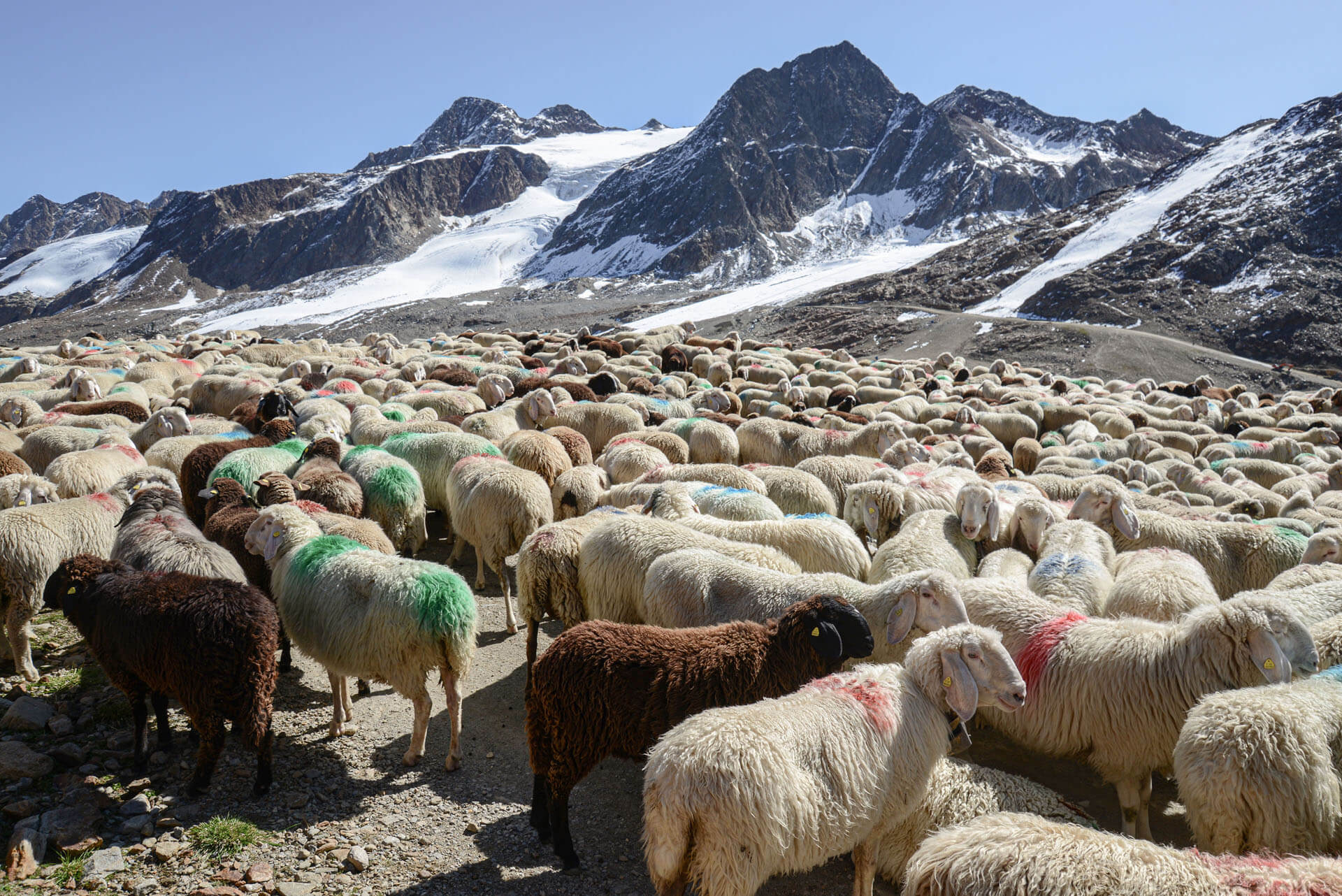
Sheep breeders for thousands of years
A commonly accepted theory is that the term pecunia derives from pecus, i.e. sheep, as owning many sheep was synonymous with wealth. This emphasises the importance that sheep once had; and from the Lex Baiovarorum from the 8th century AD we learn that a debtor could have all his goods seized in the event of insolvency, but sheep could only be seized if there was nothing else left! However, fertile land is needed to maintain and increase flocks of sheep. Now, the Alpine regions are not blessed with many such soils. In certain arid environments, livestock farming was even seasonal, as the high altitude, steep and exposed terrain, months of snowfall and other factors forced sheep farmers thousands of years ago to constantly move in search of new pastures. This gave rise to nomadism, the oldest form of migration of livestock and humans, which can probably be seen as the cause of the eternal conflict between nomads and sedentary people; symbolised in the story of the confrontation between the (nomadic) shepherd Abel, who is killed by the (sedentary) farmer Cain.
With regard to wealth and livestock farming, it is also worth reflecting on what happened in the Scottish Highlands in the mid-18th century: a phenomenon can be observed that formed the basis for the industrial revolution and modern capitalism; and again, sheep played a crucial role in this. The large landowners forced the small farmers to migrate in order to make room for thousands of sheep, whose wool supplied an entire industry and guaranteed a much higher income per hectare. This ‘operation’, wanted by the English government, was called the Clearances and reached its peak in 1792, a year remembered in Gaelic as Bliadhna nan Caorach, the Year of the Sheep!
The shepherd being, endlessly fascinating
In short, pastoralism is an endless and fascinating topic that has analogies with the culture of shepherds in all countries of the world. Genuine nomadism has long since disappeared and has only survived in some regions of Africa and Asia. In the Alps, on the other hand, transhumance has survived as ‘aestivation’, or ‘summer grazing’ – a reduced form of nomadism in which herds periodically move back and forth along the same routes. Since the last century, the number of transhumant flocks has declined sharply, but in certain Alpine valleys and in several European countries, especially Spain, Romania, France and Italy, thousands of sheep still migrate along ancient routes, thanks in part to EU support.
I am thinking of the ‘Canadas real’ or ‘Lligallos’, as they are called in Catalonia, which were introduced in Spain by King Alfonso of Aragon in the 15th century and are still largely in use, with a total network of over 120,000 kilometres of sheep trails that are considered a public good. Spain is the country with the largest number of sheep in Europe (15 million head!). In Romania, where up to 10 million sheep live, transhumance is still widespread in the Carpathian Mountains: It follows old routes totalling 3,000 km in length that wind their way through the mountains of Transylvania. The shepherds spend the summer here with their flocks, while they head to the Danube Delta to spend the winter. In the south of France, numerous flocks commute seasonally between Provence and the Maritime Alps, and the route between Arles and the Stura Valley stretches over 400 kilometres. In Italy, the sheep trails leading from Molise to Apulia are famous with a total length of several thousand kilometres, even if only a few of them are still used. Their age is documented by numerous finds and archaeological sites dating back to the Samnites, a people who lived in this area in the 6th century BC. Over 2,000 years ago, the Roman historian Varro wrote about his 700 sheep that spend the autumn in Apulia. He already distinguished between transhumance (pastio in saltibus) and permanent grazing (pastio in fundo).
Historical transhumance, which has a certain significance in the Alps, is linked to the shepherds from Bergamo, the so-called ‘Tesini’, who have been documented since 1204. In summer they travelled north to the Engadine as far as Chur and in winter south to the Po Valley as far as Mantua and Cremona or the Oltrepò Pavese area. The Seriana Valley was the most important centre for transhumant shepherds, and Parre was their capital. The chronicles of the time tell us that for centuries there were more sheep in this valley than inhabitants. At the beginning of the 17th century, the number of sheep gradually declined and the flourishing wool industry, which was first mentioned in writing in 1248, gave way to the silk industry. It is interesting to note that the historical relationship between sheep and shepherds is still alive today in the valleys of the Bergamo Alps. In fact, the ‘Pasturs’ project was founded here in 2015 – which has now also become established in other Alpine regions – to jointly develop solutions for the coexistence of shepherds, wolves and bears. The passage of the herds and the duration of their stays were once precisely regulated, as we learn, for example, from the statutes of the municipality of Bormio (Worms in Valtellina), which were in force from 1334 to 1797. Offenders were fined and even had their animals confiscated if they refused to pay; in addition, every Worms resident was encouraged to report the misbehaviour of passing shepherds by being promised half of the fine!
Then there were the herds that travelled from the Belluno area to Trentino or even the Ulten Valley, as well as those that descended from the Fiemme and Sugana valleys to the Veneto plain, following the course of the Piave or Livenza rivers to the Adriatic. In this country, mention must be made of the herds that crossed the Passeier Valley at the Jaufen Pass at 2,474 metres above sea level. Before I leave Val Passiria/Passeiertal, I must mention an episode that is also reported by the ethnologist Siegfried de Rachewiltz: In 1116, Duke Henry IX, known as the Moor of Bavaria, gave 200 sheep to the farmers of this valley on the occasion of the consecration of the church of St Leonhard! What was the reason? Did he want to promote livestock farming or rather keep the inhabitants of this valley, through which an important transalpine road ran, in the valley? We must not forget that Tyrol was not yet a political entity at the time, but belonged to the Archduchy of Bavaria. At that time it was referred to as ‘Land im Gebirge’. It was not mentioned as ‘dominium comitis Tyrolis’ until 1248 and is even mentioned under the name ‘Tiralli’ in Dante Alighieri’s Divine Comedy!
There were also herds that travelled from Welschnofen over the Karer Pass to the pastures in the Fleims Valley. Another transhumance, or summer pasture, which is at least worth mentioning due to the altitude reached and the number of animals, leads from the Langtauferer Valley in South Tyrol over the Weißseejoch at 3,046 metres above sea level to the pastures in the Kaunertal in Austria. A few years ago there were still 1,400 sheep, today there are only around 800. This form of transhumance at fixed times and in fixed places survives to this day thanks to precise rules that have been codified and updated over the centuries.
The subject is extensive and well documented in numerous communities throughout the Alpine region. This shows that shepherds often belong to families who have been practising this difficult craft for generations and have always passed on their knowledge. A good shepherd must not only know the routes, rights and duties in detail, but also be able to predict changes in the weather, which can dramatically end the march in the mountains, as the numerous votive offerings in many churches and chapels along the transhumance routes show. The shepherd must also know how to look after the animals and, of course, he must also look after himself. That is why it is said that it takes longer to train a good shepherd than a doctor! It is no coincidence that there are countless popular sayings and proverbs involving sheep and shepherds: a click on the internet is enough to realise this.
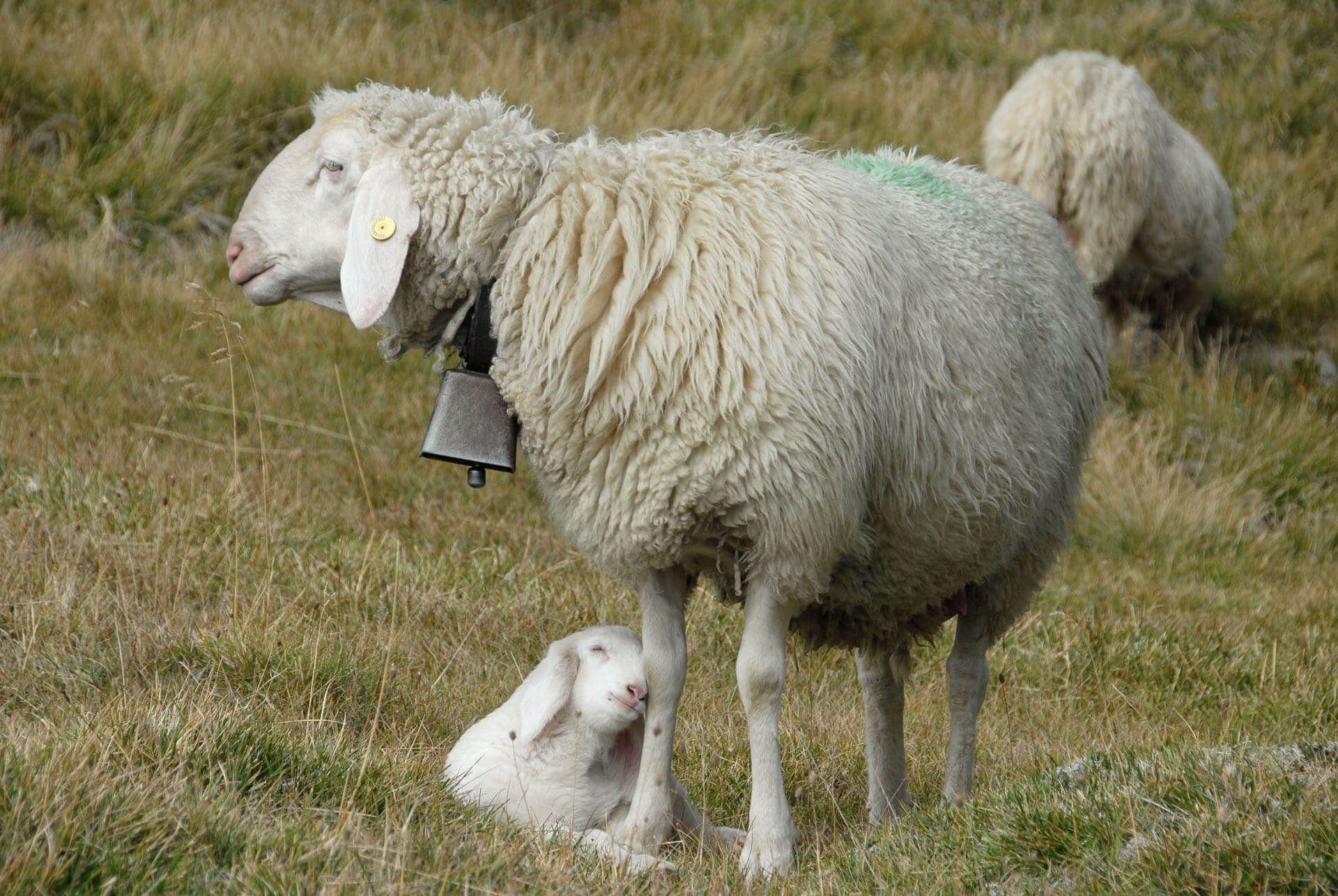
Sheep and shepherd customs are still celebrated in the Alps, three of which I was able to document. In Virgen in East Tyrol, an atmospheric ceremony takes place every year on the second Friday after Easter, during which a billy goat decorated with colourful ribbons is brought into the church and driven around the altar, where it takes the sins of all those present upon itself to then be taken outside as a scapegoat and auctioned off. In the past, the goat was actually sacrificed and its cooked meat distributed to the poor. In Worms in Valtellina (Bormio), it is customary to go to church for Easter mass with newborn lambs on your lap, which are blessed together with the roast sheep prepared at home beforehand.
In Mendatica in the Ligurian hinterland, sheep and shepherds go to church for Christmas mass! There are various forms of flock management: in some cases, the shepherds also own the sheep and make their profit from the sale of the sheep, lambs and wool; others manage the flock on behalf of various owners, from whom they are paid at the end of the season, and there are also mixed forms between owners and free shepherds.
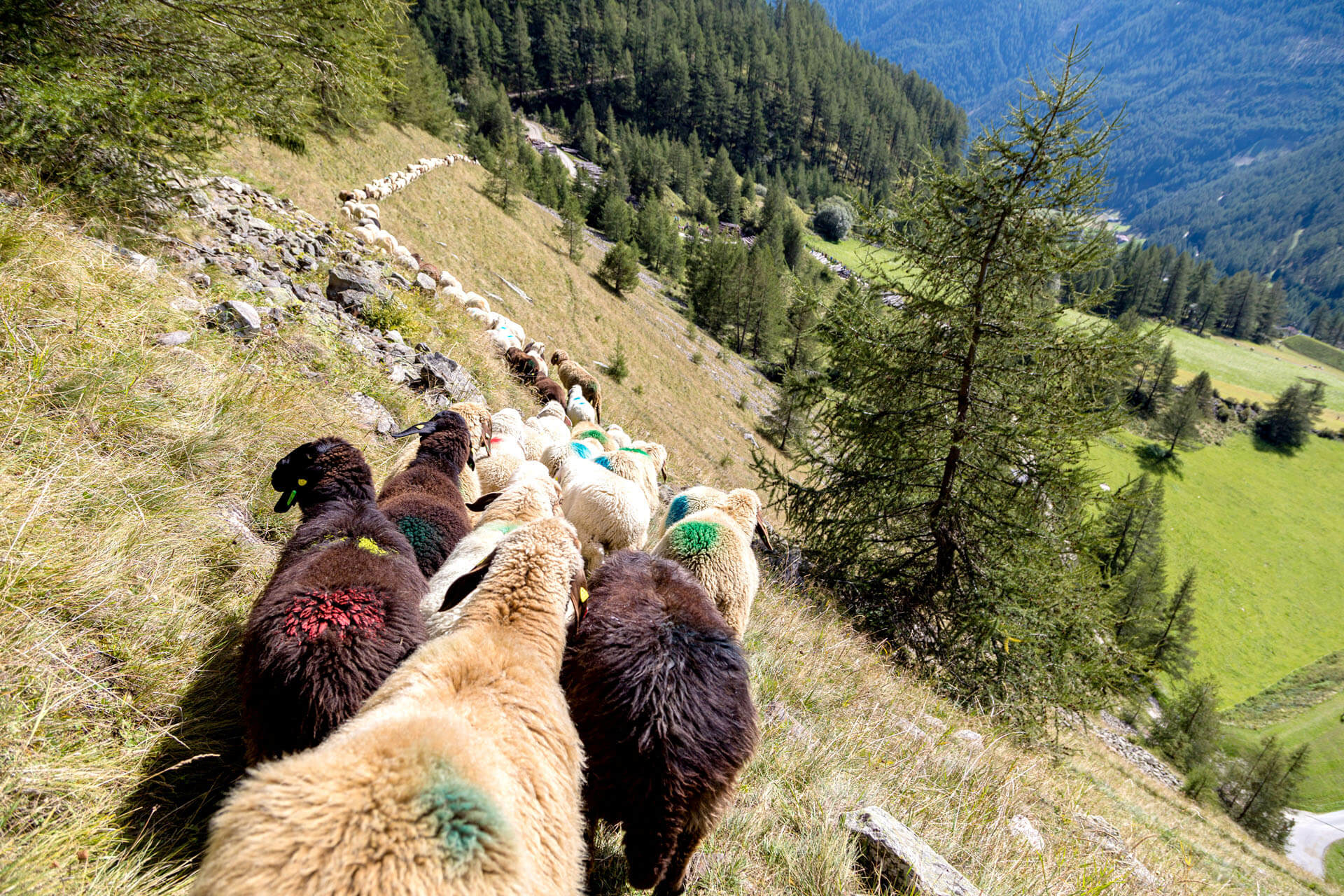
As already mentioned, the topic is extensive and goes beyond the scope of this research, which is mainly concerned with the transhumance of sheep from Val Venosta and Val Senales in South Tyrol to Ötztal in Austria. According to various written sources, the highest transhumance in Europe has been taking place here every year for more than half a millennium. To this day, around 3,000 sheep are led over the main Alpine ridge, overcoming a total of 3,000 metres in altitude and crossing ever smaller glaciers that connect the Schnalstal Valley in South Tyrol with the Ötztal Valley in Austria. However, this raises a problem: is it appropriate to use the term transhumance in this case? After an exhausting three-day hike, the sheep reach the summer pasture, where they then stay for the whole summer. The correct term would therefore be summer pasture or summer pasture. This defines the practice of taking the sheep to high-altitude mountain pastures for around three months of the year, while they spend the rest of the year near their original farms and are housed in stables during the winter months, where they are fed with the hay harvested in summer. Some people also insist on distinguishing between vertical and horizontal transhumance. I don’t want to delve any further into the dispute about the correct term, but instead report on this unusual transhumance method.


Pasture farming in the Schnalstal Valley
The oldest document known to us dates back to 1415, is written in Latin and speaks of an agreement between the farmers of Schnals and those of Vent regarding the purchase of pastureland in the upper Ötztal valley. In this very detailed document, in which it is often repeated that it was written for the present, but also for ‘eorum heredibus et successoribus’, toponyms are used to define the exact boundaries, which are still known today with minor variations, such as: the Ach Bach, today Ache, the Romalspitze, today Ramolkogel, or ‘lapidem concavum vulgariter Hollenstain’, today Hohlerstein.
In 1434, a further document written in German clarified a number of points, mainly concerning the farmers of Rofen and Vent, whose land originally consisted only of alpine pastures. However, the earlier agreement is confirmed once again by granting the Schnals shepherds the right to descend further down the mountain, i.e. onto the land of the Vent farmers, in the event of persistent snowfall (right of snow escape), a right that was last exercised in 1987! Vent (Vend) was first mentioned in 1241, but it was not stated whether it was a single farm or several. In 1295, ‘ein hof in Vende ze Rouen’ is mentioned in a herbarium of Tyrol Castle. The development of a Schwaighof farm in the Schnalstal Valley area, which became an autonomous municipality and later a municipality within a century, is thus well documented.
The Schnals ‘Elle’
As the famous historian Fernand Braudel noted, wool processing was the oldest form of industrialisation. However, loden from the Schnals Valley was already so sought-after that from 1354 it was measured and sold using the Schnals ‘arm’ (i.e. Schnals ‘Elle’), a truly rare privilege. The demand for this quality product was so great that for a long time the weavers in Val Senales were forced to buy wool from many villages in Val Venosta to meet demand. Perhaps this is why the saying ‘the people of Val Senales have deep pockets’ originated, probably alluding to the deep pockets full of coins with which they went to the markets to make their purchases! Before loden, there was felt, which was mentioned as early as the 3rd century BC and was used by mountain dwellers to dress themselves. It was made from carded wool, but was not woven, but simply beaten, soaked and pressed into waterproof, firm pieces. Legend attributes its ‘invention’ to St James.
It is difficult to determine with certainty the beginning of grazing activity in the Schnalstal Valley; certain archaeological finds, even at higher altitudes, testify to the presence of humans at certain times of the year, at least on the southern slope (Tiesental, Finailtal, Fallerbach, Maneid, Ganglegg), where, in addition to pollen, which indicates perhaps only occasional grazing activity from 5. 000 BC, semi-worked flints, spindle moulds, pottery fragments and sheep bones with votive engravings dating back several millennia were found. But also on the other side of the Alps (Kaser, Hohlenstein above Vent, Gurglalm, Obergurgl/Beilstein or the Brunnenboden above Rofen) traces of pasture fires dating back to 4,300 BC were discovered as well as finds from various eras, from the Mesolithic to Roman times. However, there is no evidence of permanent settlements from the Neolithic period or the Copper Age – the time of Ötzi (5,300 years ago).
Ötzi the Iceman
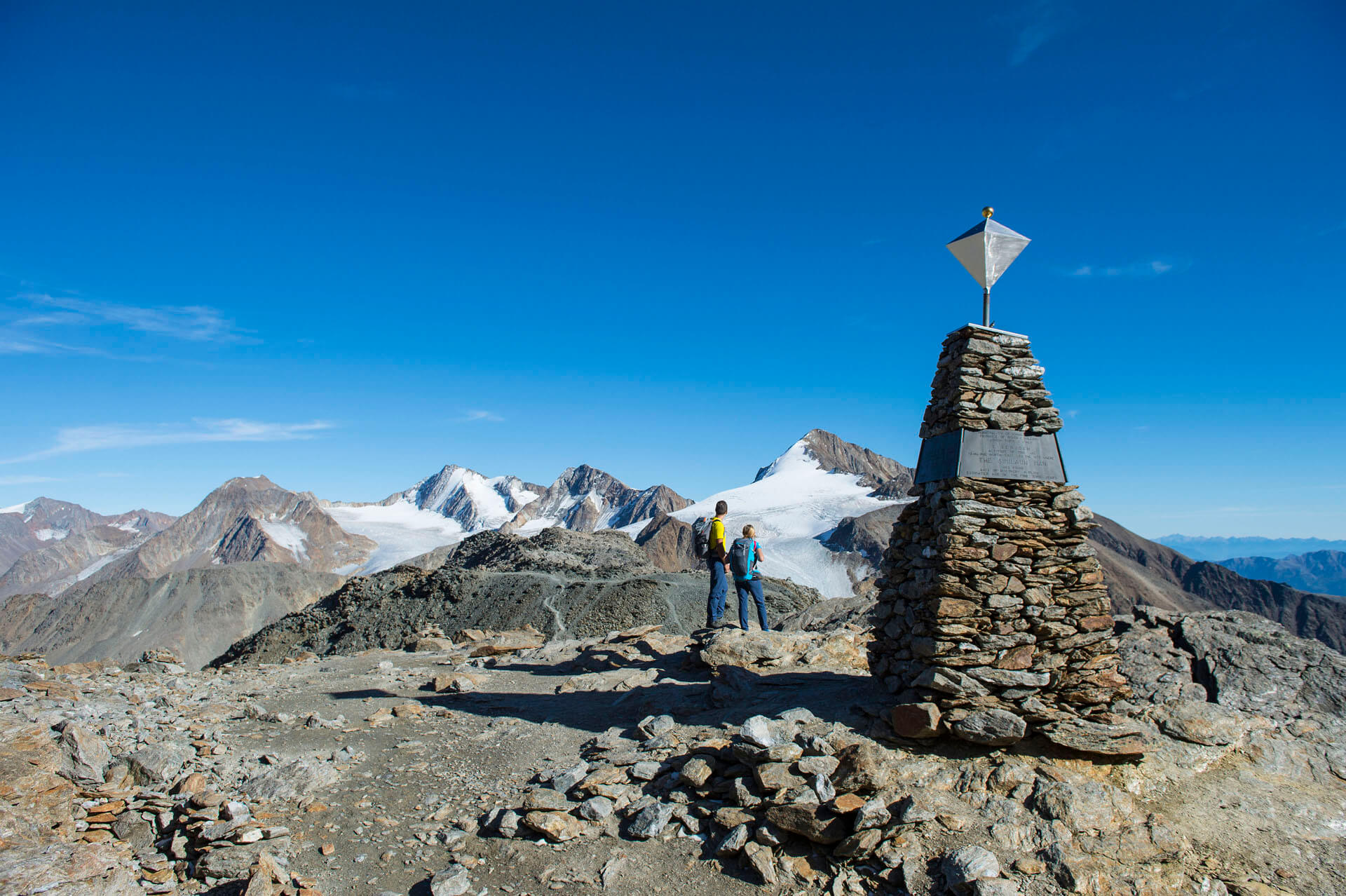
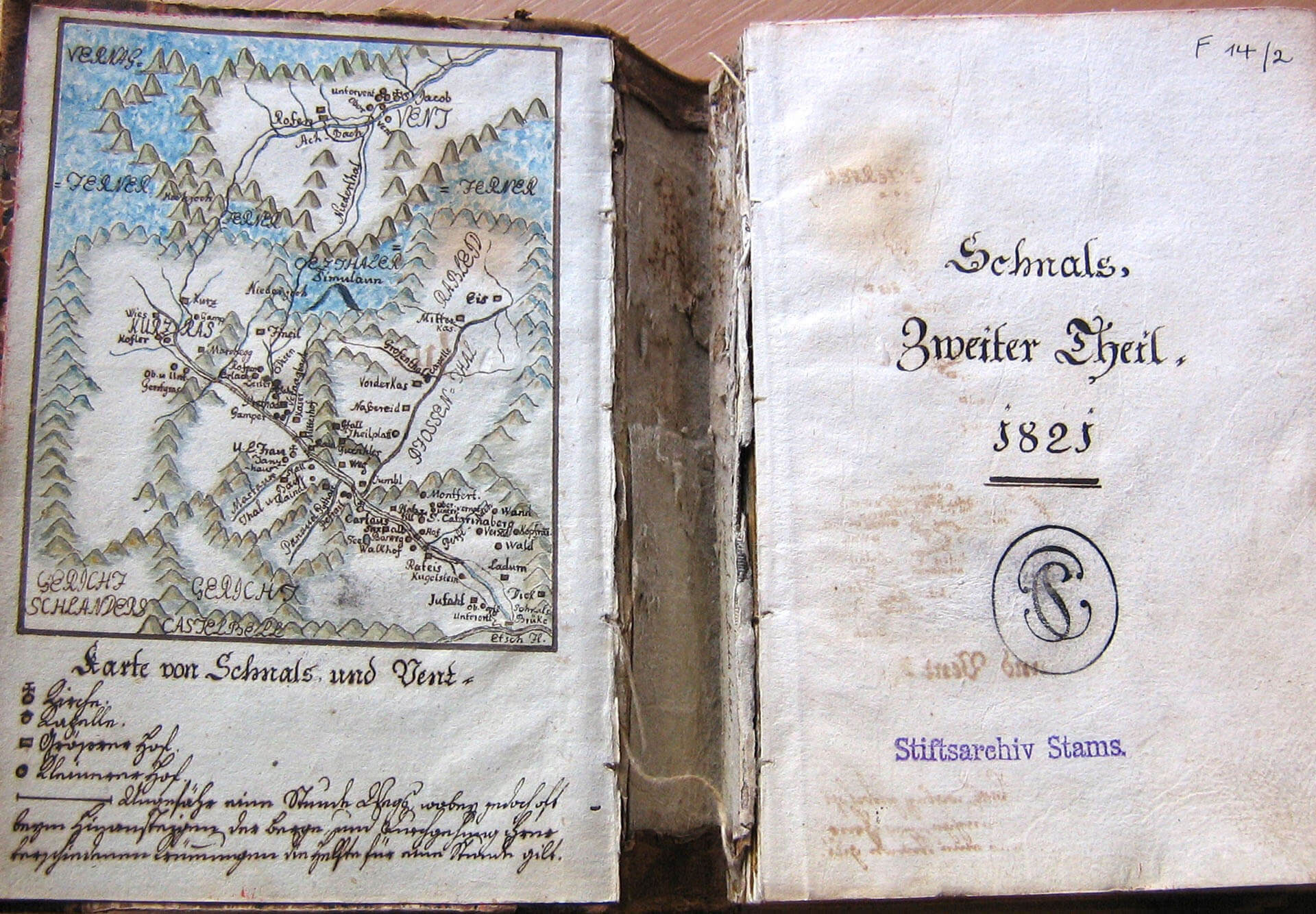
The accidental discovery of the ‘Iceman’ – commonly referred to as Ötzi – in 1991 on the Tisenjoch pass on the border between the Schnalstal and Ötztal valleys raised the question of whether he was a shepherd. In addition to weapons and various artefacts, the numerous objects found with him also included his clothing, some of which had been made from goatskins. However, what allows speculation as to whether he and his people were already practising sheep farming is the site itself. In a letter from 1821, which is kept in the parish archives of Unser Frau in Schnals, the parish priest Joseph Ladurner describes in detail to a friend from Meran the route he has to take on certain occasions to celebrate mass in Vent (because, as we will see later, the souls of the faithful in the upper Ötztal valley were looked after from the Schnalstal valley for a long time). In this letter the priest writes: ‘… the path from Unser Frau in Schnals to Vent continues east of the Niederjoch on the glacier to the left of the Similaun. At first it takes three strenuous hours to reach the glacier, which is visible from the church of Our Lady in Schnals. The crossing takes one hour and from the mouth of the glacier to the church of St. Jakob in Vent is another three hours. From the Gamper farmstead, it’s a total of seven hours of steep hiking on the challenging trail, which is only accessible from the end of May to the end of September…’.
So we learn that from the former Niederjoch, before that Schnalserjoch, today called Tisenjoch, you could see the Church of Our Lady in Schnals. This is no longer possible today, as the construction of the Similaun hut in 1899 moved the route and thus the name of the pass further south! The place where Ötzi was found, however, corresponds exactly to the old path described by the priest and was used until then for transhumance of the sheep! In 1997, an axe handle from around 2,700 BC was found just a few steps away from the Tisenjoch (3,240 m), where Ötzi had been found. So 500 years after him, someone was still travelling along this path!
In 2003, a very well-preserved snowshoe made of birch wood was found on the Gurglereisjoch (3,134 m) in the Pfossental valley – the same place where the sheep passed by until 1963 thanks to the retreat of the glaciers – with a C14 date of around 5,800 years! Later excavations also revealed the remains of a medieval sledge and other artefacts confirming the continuous use of this pass. Near the Taschljöchl, which connects the upper Schnalstal Valley with the Schlandrauntal Valley and thus with the Vinschgau Valley, a cone from the Bronze Age was found: Herds have always travelled over this yoke. Remains of settlements from the Bronze Age have been found both in the Tisental Valley at the so-called snail and on the Jochwiese and Finailtal valleys.
These finds therefore make a decisive contribution to strengthening the hypothesis of continuity in the use of these paths, which are still frequented by shepherds and their herds today, even if it cannot be proven with certainty that regular transhumant grazing was already practised at the time of Ötzi. In any case, no traces have yet been found that prove a permanent settlement in this valley in prehistoric times. There are sites dating back to the Bronze Age, but the interpretation of the finds tends to categorise them as temporary and in some cases as cult sites, such as the one in the Finail Valley, from which very rare amber and glass bead artefacts have come to light, or the one in the Maneid Valley, where sheep passed through until recently. Perhaps the men also climbed the mountain seasonally to hunt, and some artefacts, such as Ötzi’s bow and arrow, testify to probable hunting activity.
The most recent discovery, chronologically speaking, is the extraordinary discovery of the remains of a dozen ibex in the Ötztal Alps on the Lodner (2022), which are about 7,000 years old! But let’s return to the more recent past and resume research into the origins of the permanent human presence and thus later transhumance in Val Senales, starting with the earliest available written documents.
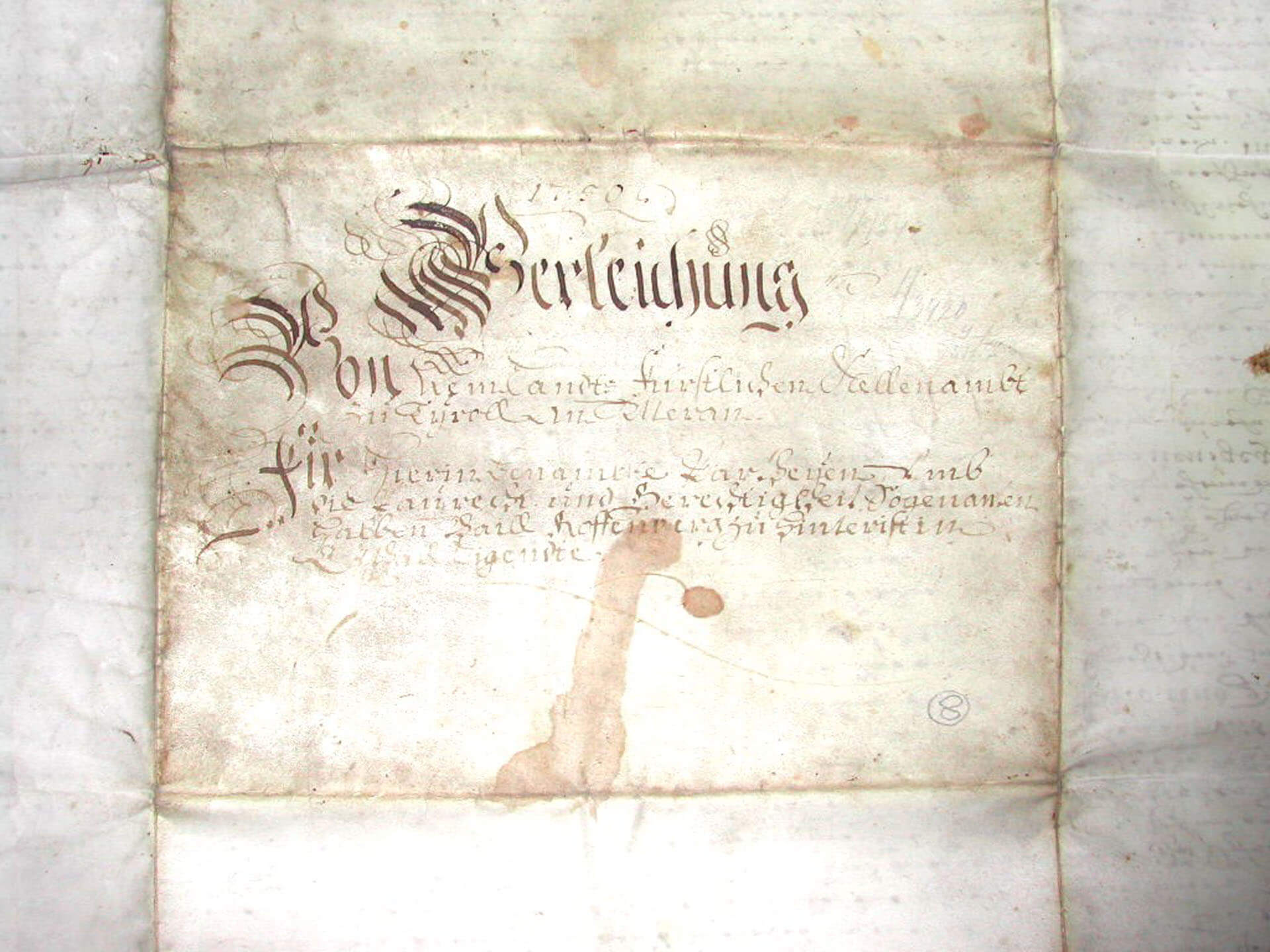
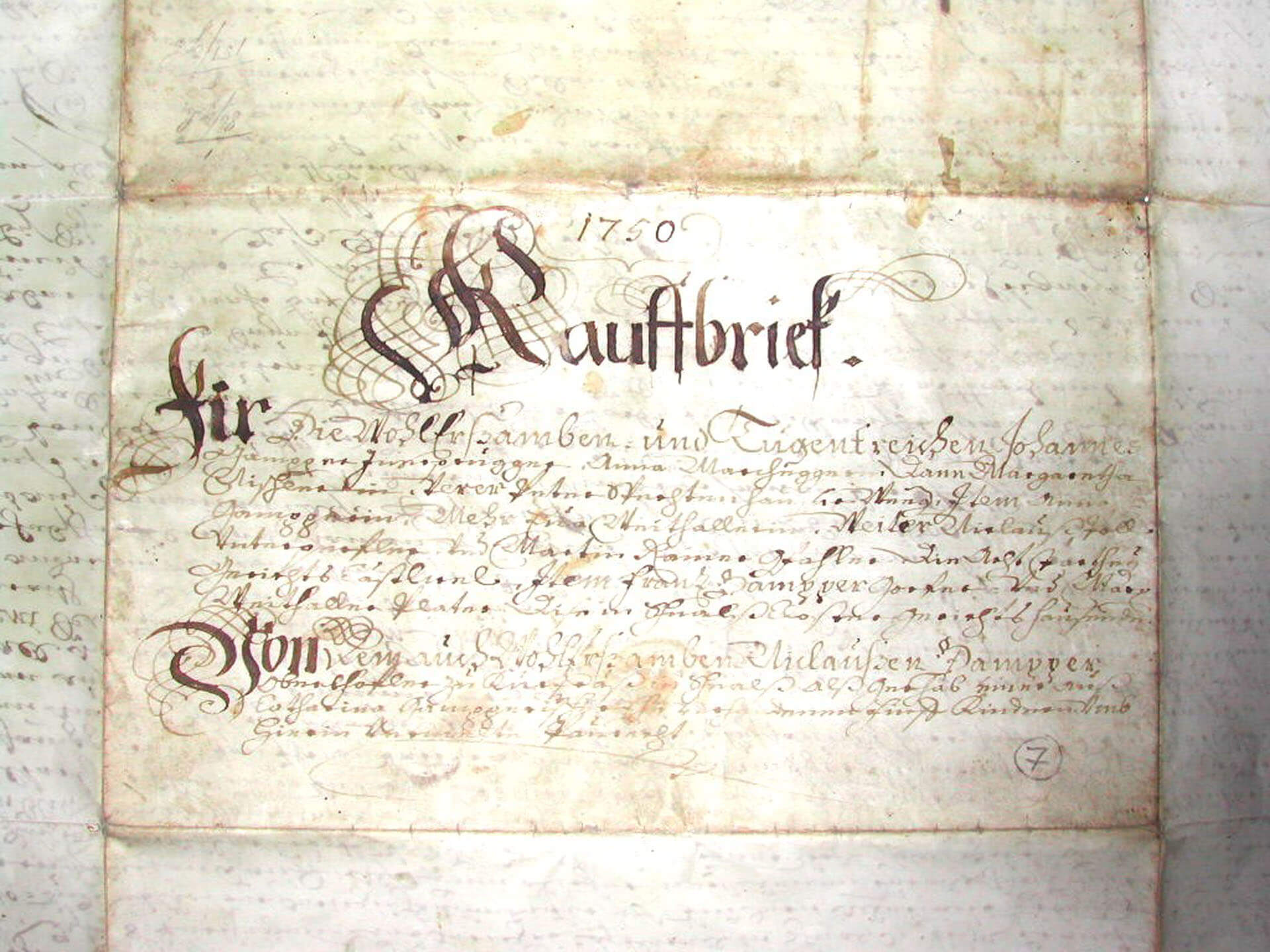
Carthusian monastery contract
From 1361, there is a contract from the Carthusian monastery, written by the judge of Castelbello, in which the farmers of the Tuesener, Vyneil, Rofein, Mayer and Mastaun farms are asked to ensure that their animals graze on their mountains (‘shall remain in their mountain with it’). A reference that is based on historical facts and would confirm the common practice in livestock farming. We know that the local lords of the Middle Ages promoted and supported the colonisation of the higher altitudes in order to increase their income. In fact, the lower altitudes were already largely colonised so that the farmers could concentrate on the more profitable livestock farming and thus also on the production of dairy products or the cultivation of cereals. However, above a certain altitude, the barren and steep pastures were no longer suitable for cattle (it has been calculated that a cow requires on average seven times as much fodder as a sheep), so they had to concentrate mainly on less demanding animals such as sheep and goats. This gave birth to the idea of the ‘extreme’ Schweighöfe. The term is derived from the old German word Schweig, which means herd. These ‘extreme’ farms specialised in the production of sheep’s milk and its derivatives. In these cases, the local landlords provided the farmers with wood to build the dwellings, a certain number of five or six cattle, some goats and 20 or 30 sheep, which multiplied naturally and increased the capital to make them live in this difficult situation.
Goat's milk is very digestible
In return, they had to supply the farm with a certain amount of dairy products, hides and sheep each year, the meat of which was highly prized. The account books show that a high mountain farm delivered an average of up to 300 kilos of cheese per year. Before talking about sheep, however, I would like to briefly mention goats, which have never played an important role in the economy of these valleys, but are often present when travelling through them, albeit in modest numbers. Goat’s milk is very digestible, so that every shepherd brought at least one goat to provide him with milk every day. Goats can get by with less rich pastures, climb almost anywhere and even eat the bark of young trees, and perhaps precisely because of this characteristic they never found much favour with the mountain farmers because they saw goats as a threat to the growth of the forest!
Many of these farms have since been abandoned or have become seasonal mountain pastures, such as the Metzlaun Hof at 2,033 metres and the Eishöfe in the Pfossental, which is located at 2,071 metres and was mentioned as early as 1290 and was inhabited all year round until 1897. From the book ‘Der Verbothene Steig’ by Pastor Ladurner, we learn that in the first half of the 19th century, each farm in the Schnalstal Valley bred an average of 60 to 100 sheep, some of which were sold to farmers in the Passeiertal Valley for slaughter in spring and to farmers in the Ötztal Valley for breeding in autumn. We also know that from around 1600 to 1850 there was a ‘Little Ice Age’ in the Alpine region, which was accompanied by the growth of glaciers and a drop in average temperatures, factors that certainly influenced the abandonment of certain farms at higher altitudes.
Frederick with the empty pockets
Perhaps the numerous legends, which tell the same story in different variations, originate from this time: there are flourishing settlements or mountain pastures where poor strangers arrive and ask for hospitality. When the inhabitants refuse, they leave with a curse, and shortly afterwards it begins to snow relentlessly and the settlement disappears under a blanket of frost! Many of the legends that have been passed down orally for centuries and were written down in the last century are about the inhabitants of the Schnals and Venter valleys, and many of them involve sheep and shepherds. The most famous of these is undoubtedly ‘Frederick with the empty pocket’ – not a legendary figure, but Frederick IV, Duke of Austria, who once fell out of favour, had to flee in 1416 and hide on the farms of Rofen and Finail, where he herded sheep until he managed to regain power. Sheep not only provided meat, milk and wool, but also strings for musical instruments were made from their intestines; their skins, processed according to all the rules of the art, replaced the glass for the small windows of farmhouses or were made into parchment, a much sought-after material for the monasteries, where old texts for the lords’ libraries were copied by hand and on which contracts and agreements, which also concerned “our” sheep, were written down and have been handed down to this day. With the advent of printing and the accompanying use of paper, the demand for parchment declined, but we know that when Johannes Gutenberg printed the first Bible in 1452, he made 150 copies on paper and even 30 on parchment, and considering that thousands of pages were needed, you can imagine how many sheep had to shed their skins!
Then there is the lanolin contained in the wool, which is used for cosmetic products. Finally, there is the dung, which played a crucial role in enriching the generally poor grazing land and was accepted and recognised by the owners of the land along the sheep trails as a reward when a flock stopped for the night. There is an unusual but curious report about the dung from the pen of Archduke Johann von Habsburg, who often spent time in his beloved Tyrolean mountains. On 7 July 1846, he set off from Vent via the Niederjoch to Schnals. Before leaving, he bought a white woollen coat, for which he paid three guilders and whose quality he praised. The day was not the clearest, low-hanging clouds restricted visibility and made orientation difficult (the path was not yet as well signposted as it is today), but he reached the pass and happily descended into the Schnals Valley. Here he spent the night and praised the character of the valley’s inhabitants in his diary, the excellent marmot meat, and he did not forget to advise those who wanted to go the same way to follow the little dung balls that indicated the path of the sheep and thus the safe route!
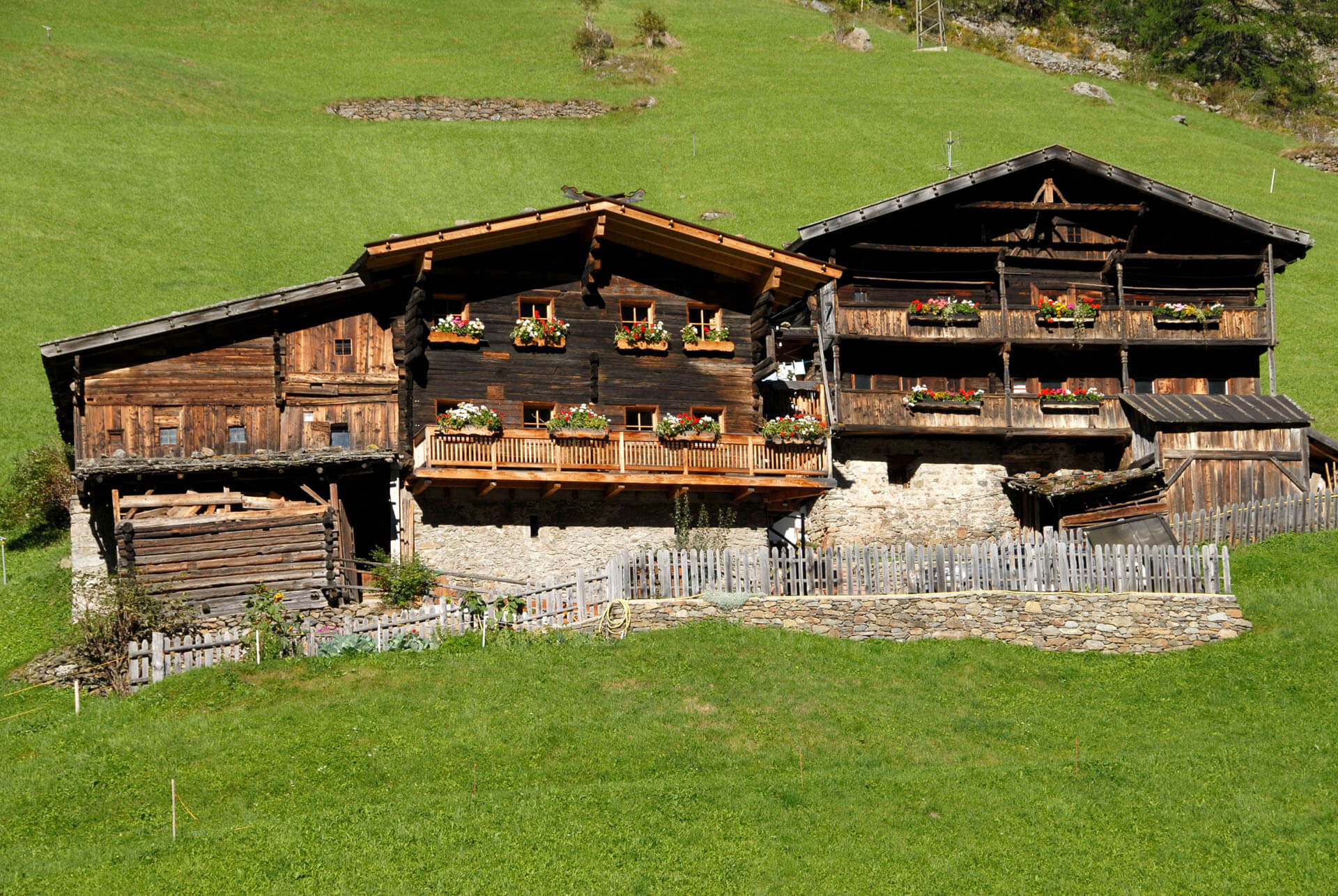
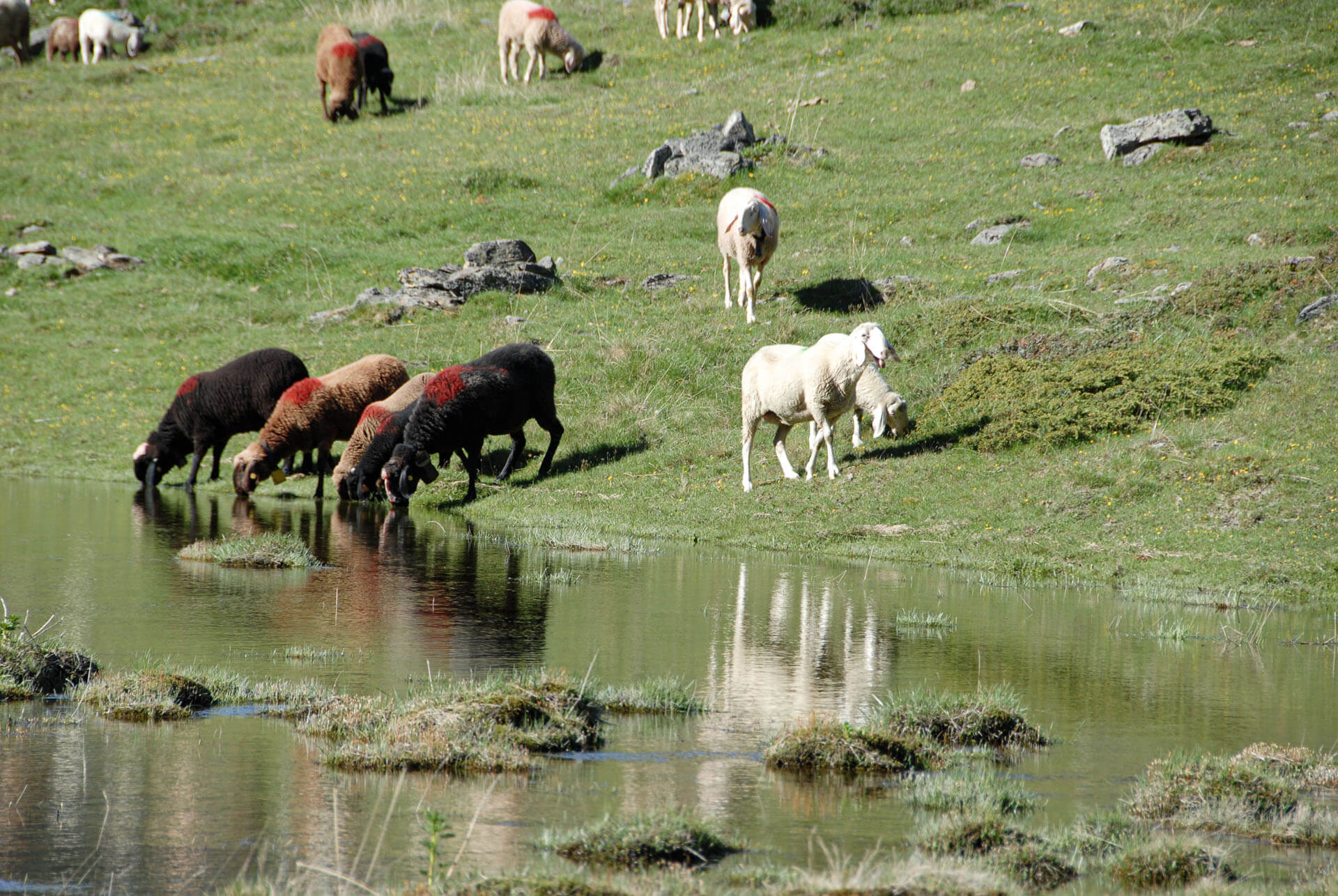
Vende valli Snals
It should be noted that the mountain region analysed in this study encompasses the territory of municipalities that belonged to Tyrol until 1919 and were therefore part of the Austro-Hungarian Monarchy. The mountains therefore did not represent a national border, but rather natural barriers that made the transition more difficult. With the annexation of South Tyrol to Italy, the region was divided between Italy and Austria, but Decree No. 3 of the Tyrolean Law of 1924 confirmed the ownership of the Austrian alpine pastures on the other side of the border to the farmers of Val Senales, whose territory was now in Italy.
The present-day municipality of Schnals covers an area of 210 square kilometres and is the third largest municipality in the province of Bolzano after Sarntal and Mals. It refers to the valley of the same name, which is around 25 kilometres long and branches off from the Vinschgau Valley. The lowest point is near the Altratheis farmstead at 840 metres above sea level, the highest point is the Hintere Schwärze peak at 3,624 metres. Along the route there are several smaller side valleys in the municipal area, some of which are at least partially part of the Texelgruppe Nature Park. These valleys are home to some of the highest farmsteads in the Eastern Alps, which are still inhabited all year round. And it is precisely these farms, many of which date back to the Middle Ages (the oldest mention of the Tumlhof farm dates back to 1230), that are the historical origin of the settlement of the Schnalstal Valley.
It was originally the Lords of Montalban, who are mentioned in a document from 1273 as Lords of ‘Snalles’ and feudal lords of the Counts of Tyrol, who promoted the first settlements at altitude. Perhaps they resided in a castle or a tower, which stood on the site of today’s St Catherine’s Church, and owned the farms in the valley. However, Meinhard II had already acquired the property by 1295 and the family had died out. We have already discussed the founding of the Schweighöfe and know that there were at least 105 farms in the valley.
In 1326, King Henry II, Duke of Tyrol, supported the establishment of the Carthusian monastery of All Saints, to which he initially donated a dowry of eight farms to supply the monks with food, wool, timber and firewood. Over time, the monastery also acquired extensive fishing rights along the River Adige as far as the lake of St. Valentin auf der Haide near the Resia Pass, as well as vineyards and buildings near Merano. The history of the Carthusian monks shaped the history of the entire valley, and when the monastery was dissolved in 1782 by order of Emperor Joseph, it already owned two thirds of the farms in Val Senales! Furthermore, after countless lawsuits against the farmers of Kastelbell, the monastery also owned a large part of the Penaudtal valley and the mountain pasture of the same name at an altitude of 2,316 metres. It is therefore not surprising that during the peasant uprising of 1525, the monastery was stormed and the peasants destroyed a large part of the documents kept in the archives, which testified to the various rights acquired over the years.
However, other stories also play a role in this Alpine valley. Until 1572, eight farms in the upper valley, i.e. from today’s Vernagt reservoir to Kurzras, belonged to the parish of Göflan (near Schlanders) from an ecclesiastical point of view, and in order to attend mass or bury their dead, the faithful had to walk for more than seven hours over the Taschljöchl and the Fallerbach. It is said that the dead were kept cool in the attic during the winter months to await the fine weather, which made it easier to cross the pass at an altitude of 2,772 metres.
And it was precisely in 1572 that the representatives of the farmers appeared before Judge Foelser and the prelates of the church of St. Martin in Göflan and, in return for a payment of five guilders, agreed to separate from this distant church and join the neighbouring parish of Unser Frau, which had already been founded in 1499.
The oldest mention of Vent dates back to 1241 and speaks of several extreme farms belonging to Ulrich von Ulten. In 1290, a farm in Rofen near Vent is mentioned, which from 1390 had to deliver 200 wheels of cheese a year to the court in Merano, a good ten hours’ walk away! The diction ‘Vende valli Snals’, i.e. Vent in the Schnals Valley, appears in a document from 1342. We also know that the four farms that made up the municipality of Vent in the upper Ötztal valley were under the jurisdiction of the court of Kastelbell, the parish of Tschars and the diocese of Chur. But as late as the 17th century, Maximilian Hendl, judge in Kastelbell, mentioned the inhabitants of Vent in a letter as people from the Schnalstal valley (… die Venter leit in Schnalss …). From 1499 they were also associated with the parish of Our Lady, which, as we have already learnt from this letter from 1821, was a good seven hours’ walk away. The Church of St James in Vent was built in 1502.
In contrast to the Schnalstal, which is only 25 kilometres long, the Ötztal in Austria is over 60 kilometres long, so it is not surprising that the farmers in the upper valley preferred the Schnalstal, which was so ‘close’, until in 1826 they were placed under the jurisdiction of Silz in the lower Ötztal, more than ten hours’ walk away, against their will. In addition, the Ötztal valley was often flooded or interrupted by landslides and mudslides, which made downward communication difficult, while the inhabitants of Vent favoured relations with the Schnalstal valley despite its altitude and glaciers.
The village of Vent was then incorporated into the municipality of Sölden in 1854, making it the largest municipality in Austria with a good 468 square kilometres (twice the size of the municipality of Schnals)! In that year, 74 people, 6 horses, 80 cattle, 235 sheep and 75 goats lived in Vent! Today, an average of 10,000 sheep roam the Ötztal mountain pastures every summer, half of which come from South Tyrol!
While most of the farms in the Schnalstal Valley belonged to the Carthusian monastery, a good portion of the farms in the upper Ötztal Valley belonged to the Benedictine monastery of Frauenchiemsee in Bavaria and the Cistercian monastery of Stams. The farms in the Schnals Valley, which benefited from the sunny southern exposure, mainly produced grain, some of which they supplied to the Carthusians. The farmers in Ötztal, on the other hand, who were located in a more humid climate zone, had to deliver a certain amount of their famous flax to the Benedictine nuns, while the remaining flax, which was highly prized for its length and strength, was sold in many regions of Europe, so that around 1800 it was listed on the Hamburg stock exchange and was the main source of income for the valley’s inhabitants.
A report by the Innsbruck Chamber of Commerce from 1851 speaks of 168,000 kilograms of flax produced in Ötztal! In an interesting booklet from 1932, Franz Josef Gstrein dates the cultivation of hemp back to around 1600, although he has no exact documentation, but reports that a report from 1619 shows that the Ötztal farmers owed Stams Abbey not only a quota of grain, but also one sack of flax per year! According to Gstrein, the cultivation of this highly valued product prevented migration from this valley for centuries.
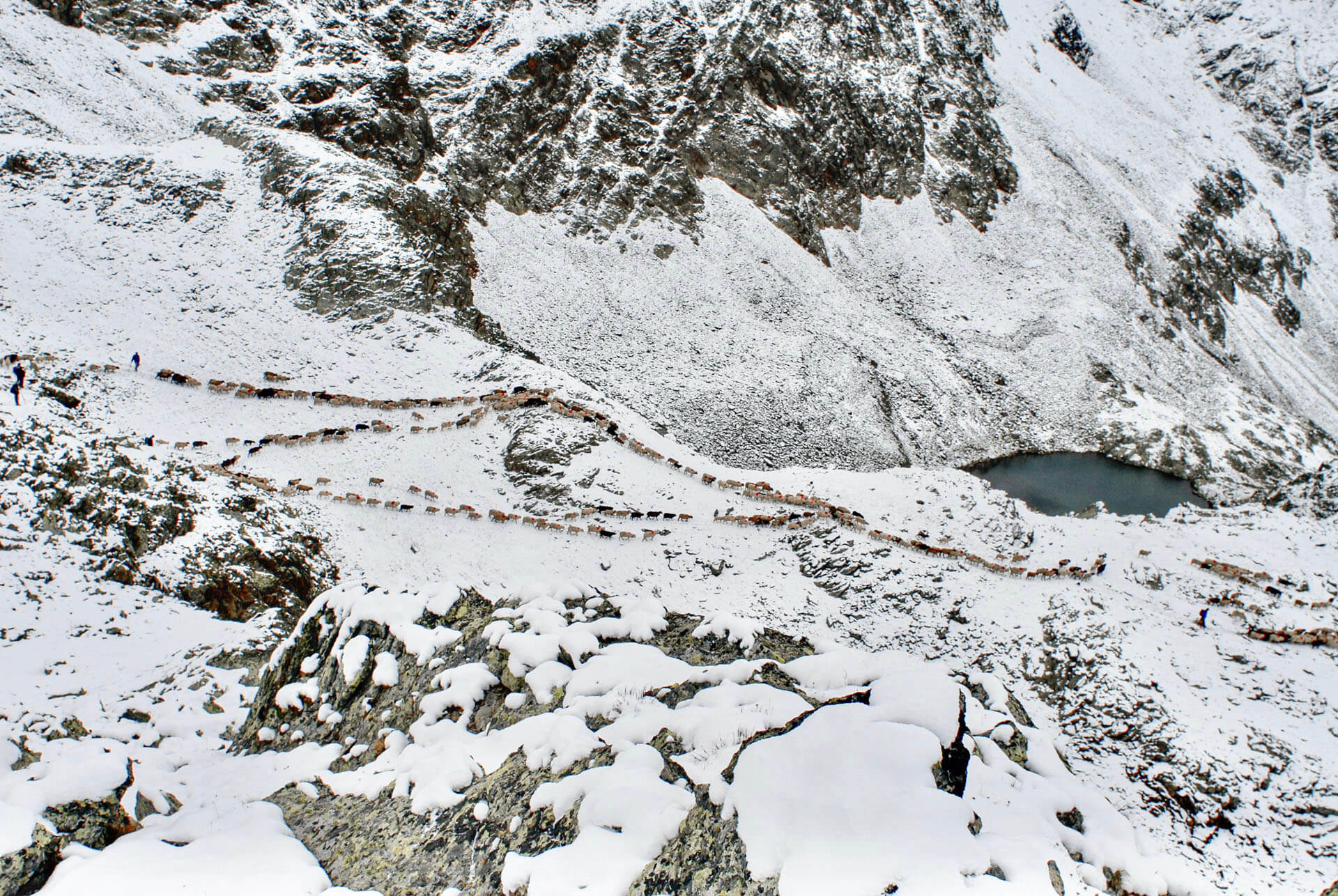
The anxious march
On the appointed days, the flocks from the various communities in South Tyrol make their way to the Schnalstal Valley, the center of this spectacular transhumance. The sheep are disinfected and rounded up at the agreed locations, they are entrusted to the shepherds, but in many cases they also accompany the owners “just to be there”, as many of them have confided to me!
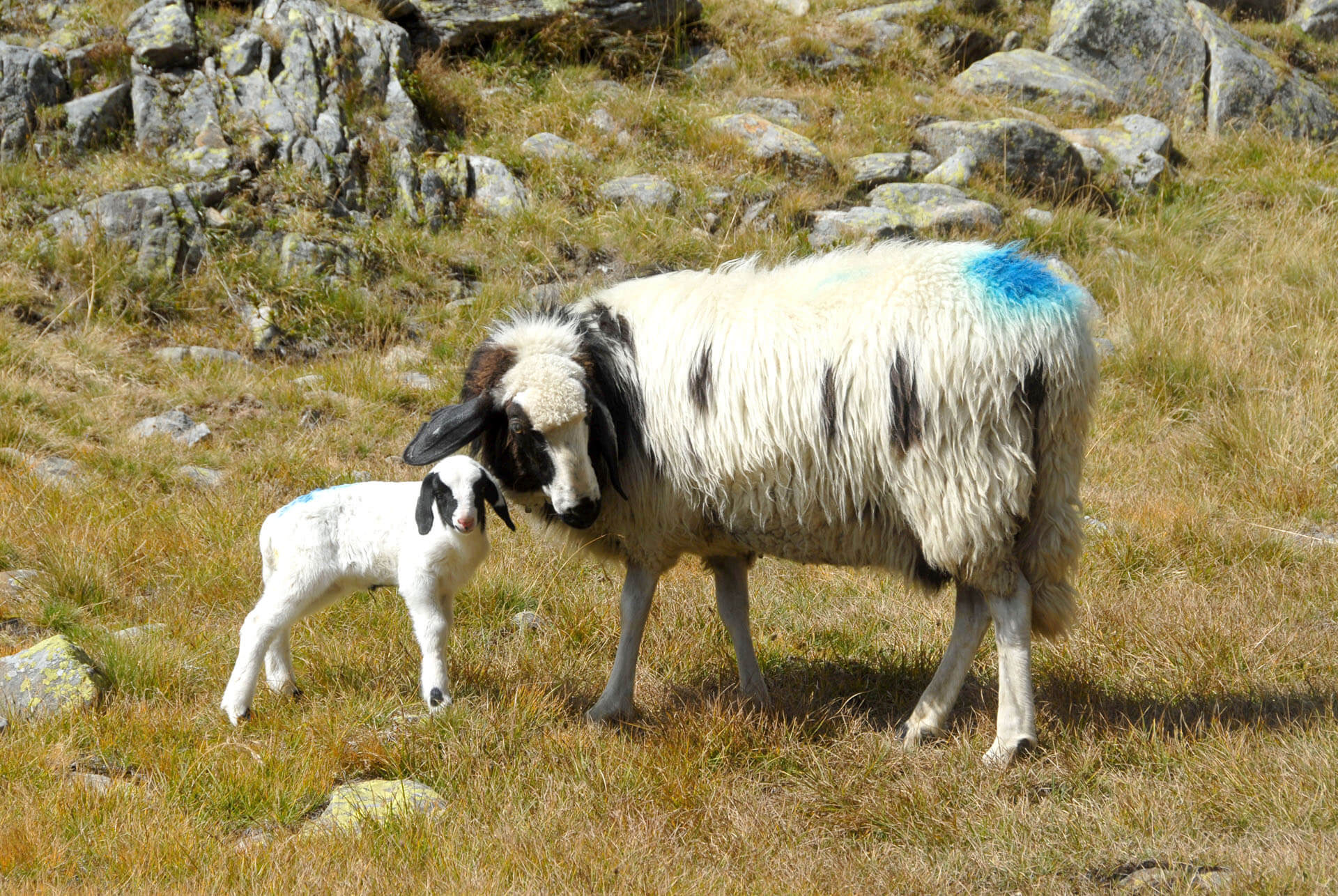
Before leaving, however, all sheep must be marked so that their owners can recognize them at the end and avoid disputes. In the past, marking was done by making diagonal cuts in the earlobes. These individual geometric “figure combinations” were drawn in a notebook and marked with the animal’s number and the owner’s name on the side. Nowadays, a label with the European code indicating the origin is attached to each animal using special tongs. In addition, the coat on the back is marked with colors that make it possible to identify the community of the sheep from a distance.
In the Schnalstal Valley, the shepherds and their helpers have a mass said in the Church of Our Lady in Schnals the day before they set off for the Untere Joch and the summer pastures above Vent. The costs of the celebration are precisely recorded in their account book, and it is perhaps curious that at least four currencies are listed in this register: florins are mentioned until 1906, then payments in crowns until 1919, then lire appear until 1998, when they are replaced by the euro! From the same document we learn, for example, that on September 25, 1879, the pasture owners of Niederthal met to approve the budget for the season just ended. The income from sheep from other communities amounted to 478 guilders, while the expenditure included 137 guilders for the purchase of salt, which, as we know, was regularly distributed at the known locations to lick the sheep, while the total remuneration of the three shepherds Sebastian Pinner, Nikodemus Manger and Josef Schlögl amounted to just 89 guilders.
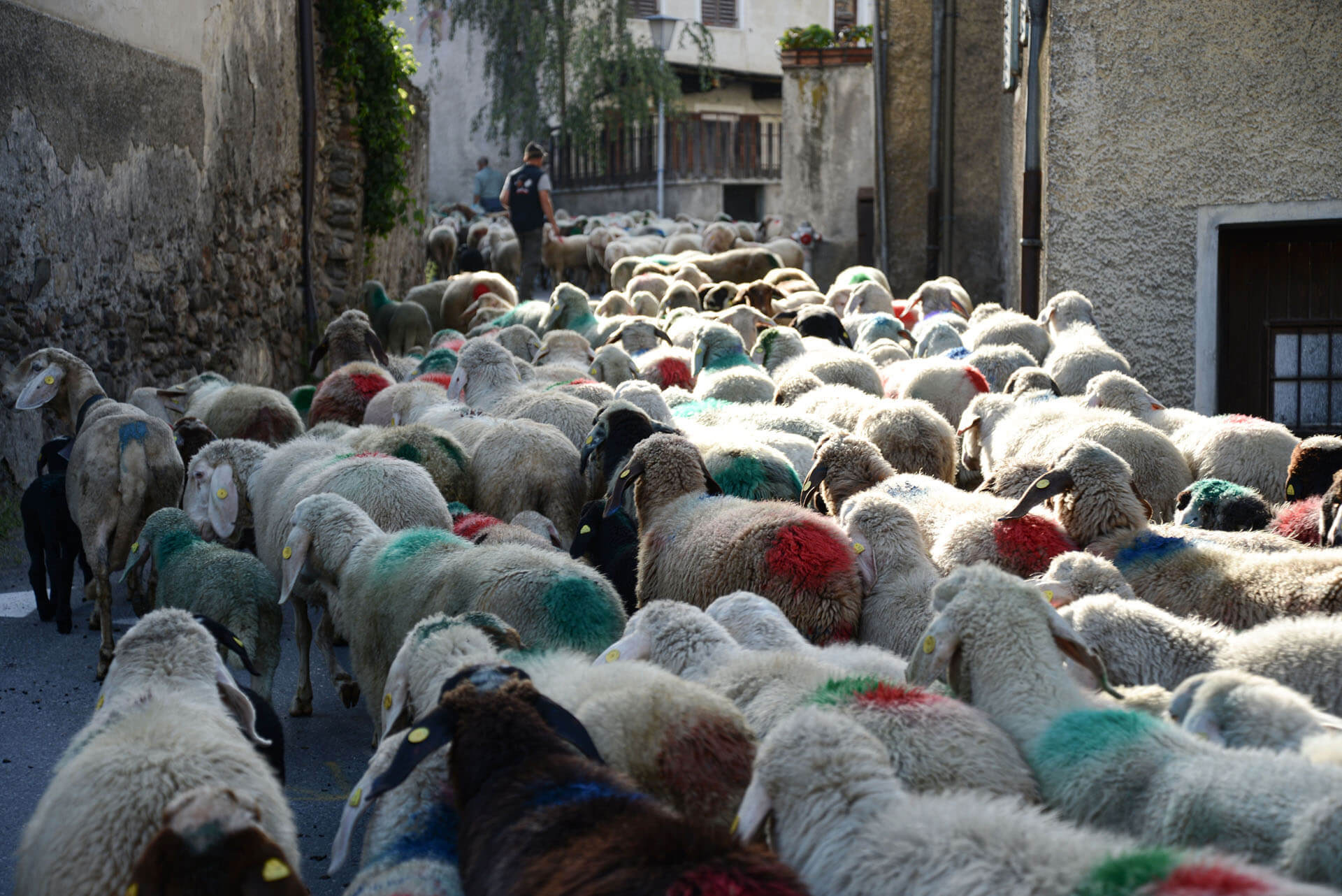
Laas
Around 50 farmers in Lasa still keep sheep, some just for fun. There are currently around 400 sheep in total, which, together with around 100 from Schluderns, 100 from Noerdersberg and 200 from Sonnenberg, make up a flock of almost 1,000 sheep. The sheep of Hans Niedermair (Waldenthaler Hans), who belonged to the Sonnenberg group, were treated “preferentially”: Unlike his fellow villagers, he drove his sheep over the Hochjochferner into the Ofental valley, to a place called Hintereis, which in his opinion offered the best grass. Years ago, the herd consisted of up to 1,600 sheep, which took three days to reach the summer pasture in the Niedertal valley. On the first day, they arrived in Pernui at an altitude of 1,700 meters. The next day, they descended via the Kortscher Alm and the Taschljöchl to Lake Vernagt, near which they spent a second night. The third stage, perhaps the most challenging, leads them into the Tisental valley, where they traditionally take a break in a wide basin, the so-called Hauser, just above the so-called Schnecke (at around 2,400 meters above sea level). They then continue along a fairly steep and rocky route, which can be very dangerous in snowfall, and after crossing the Niederjoch at 3,008 meters, they descend to Vent in the Ötztal valley.
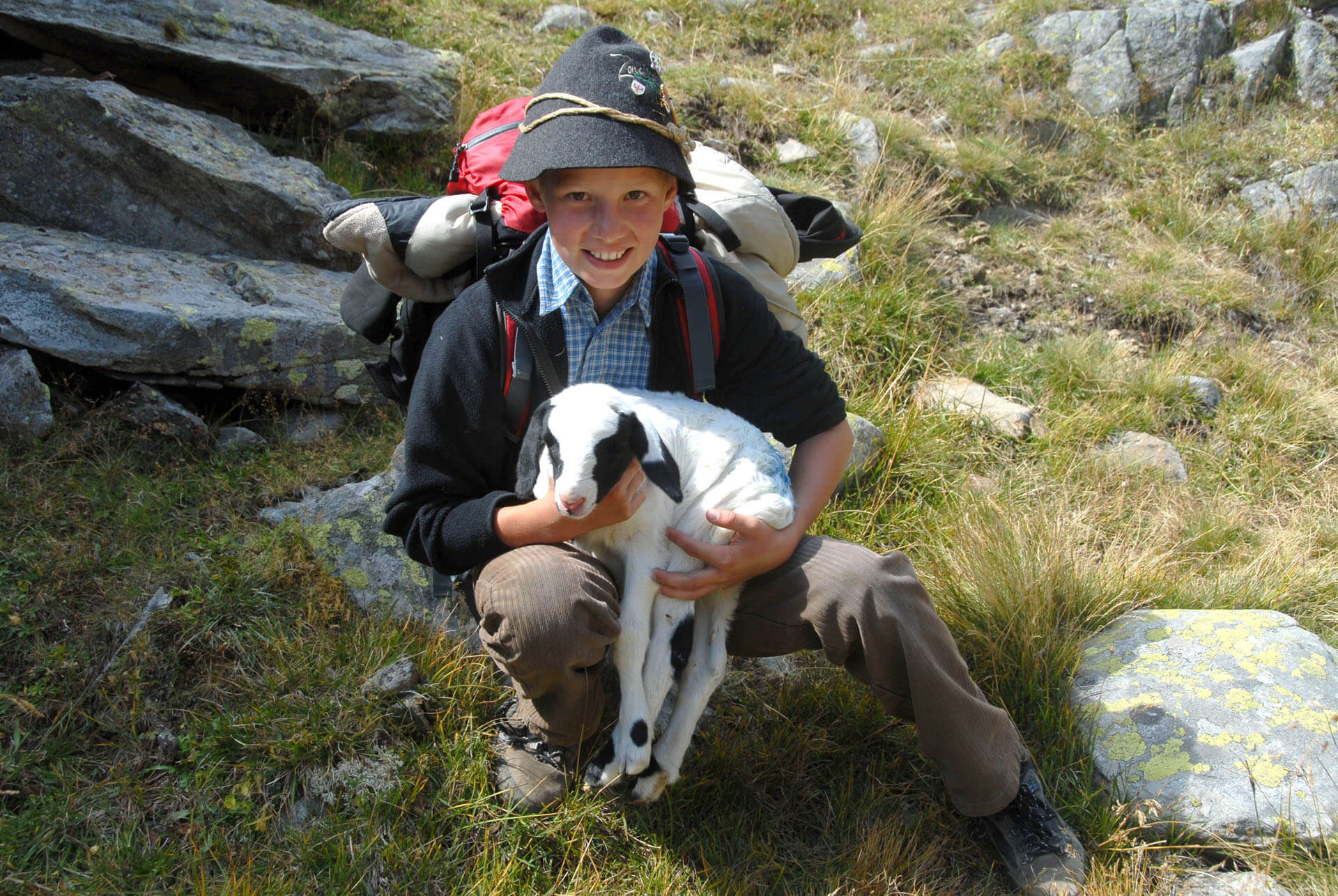
On arrival at the border, the border officials counted the sheep on the way there and placed a pebble on a flat rock at every tenth one, which a “clumsy” shepherd would sometimes stumble over by accident and cause a pebble to disappear! Since 2014, the glacier section after the Similaun hut no longer exists, so we take a leisurely descent to the village of Kaser, an ancient place of worship, to which some megalithic buildings bear witness, and to the Mother Anna spring, whose water was said to promote women’s fertility. In an “exclusive” side valley called Schalf, the sheep of Elmar Horrer graze, from whom I received a lot of information and who accompanied the sheep from Laas as a child and spent the whole summer with them in Kaser.
Kortsch – Schlanders
Kortsch, a hamlet of Schlanders, has a long tradition of sheep farming, as evidenced by the fact that the parish church is dedicated to St. John, who is depicted with the Lamb of God, as well as the altarpiece with the figures of St. Wendelin, a shepherd and hermit, and St. Ägidius, the patron saint of shepherds, to whom a small church above the village is also dedicated, right on the path that the flocks follow to reach the Schnalstal Valley. We know that about 150 years ago, the sheep of Kortsch spent the summer on the pastures of the Lyfi Alp in the Martell Valley, and there is talk of about 800 sheep from various communities, as recorded in the Martell chronicle of 1870. Around 1950, they then agreed with the shepherds from the Schnalstal Valley to use the pastures in the Niedertal Valley, and from 1980 they changed their destination again and grazed above Rofen, where they still go every year today. At that time, the Kortsch herds had reached their peak of around 1,200 animals, today there are only around 400.
In conversation with Josef Telser (also known as Oberdörfer Sepp), a 90-year-old who has been looking after the herds since he was 10 years old and has been the village’s contact person for sheep matters for years, you learn interesting and curious facts, such as how he and his colleagues found around 15 mauled sheep on the Sonnenberg, the mountain above Kortsch, around 1970. There was no talk of wolves at the time, so they realized that the perpetrators were two dogs belonging to a farmer from Allitz, who was responsible for the extensive damage. As already mentioned, there were no wolves in the area at the time because they had long since been practically eradicated. Hunters were ordered to kill wolves and bears that caused damage to domestic animals as early as 1497 in Emperor Maximilian I’s provincial ordinance: The hunters received a monetary reward for each pelt delivered. A document from 1812 shows that no fewer than four furriers were active between Silandro/Schlanders, Glorenza/Glurns and Malles/Mals! But later documents, such as that of Emperor Ferdinand I from 1526, also repeat the call to hunt wolves, a clear sign that they were a problem.
Naturally, game hunting was reserved for the nobility, but where there was game, there were always poachers, and in an edict of 1737, Emperor Charles IV forbade shepherds to harbor poachers and suggested building traps for wolves, and even today there are various places in the microtoponomastics that refer to wolves and bears (Wolfsgrub, Bärenstall, etc.). Local chronicles report the killing of wolves by professional hunters in several Venosta Valley municipalities: in 1668 two wolves in Schleis and four in Mals, in 1819 seven wolves in Stilfs, two in Schlanders.
An unusual event is reported from the year 1870: On November 30, St. Andrew’s Day, the farmer from the Matatsch farm was attacked by a lone wolf on his way home in the evening after visiting the large traditional market in Silandro/Schlanders, which he beat to death! However, no damage to the flocks is reported or mentioned.
After spending the winter in the barn or on the meadows adjacent to the farm, the sheep of Kortsch are brought to Schlarangele on April 25th, where they are washed and disinfected after being marked either with cuts on the ears that identify the owner or with colors on the fleece that highlight the municipality. They are then grazed on the slopes of the Sonnenberg, generally until the first week of June, when, after being rounded up, they are taken to the Schnalstal and then to the Ötztal, where they graze until the first week of September, when they are rounded up again after two or three days and brought back to Kortsch.
As Karl Prieth explains, the president of the goat and sheep breeding association, which currently has 26 members, is elected and remains in office for three years. They breed the sheep out of passion and not primarily for economic reasons, even if some animals are sold after returning from the alpine pastures… On the contrary: they have to pay 4 euros for disinfection, then 10 euros go to the shepherd who looks after them on the Sonnenberg in spring and fall, they pay 10 euros for the alpine pasture in the Ötztal and then another 3 euros for shearing, so that each sheep costs 27 euros. Wool that was unsaleable for years now fetches 1 euro per kilo! In short: if there were no EU subsidies, the costs would be too high and many would probably give up. But abandoning the pastures would also harm the environment, as the biodiversity of the Sonnenberg would decrease, certain dry meadows would disappear, and shrubs and forests would become more prevalent!
Various court documents from the years 1442, 1461 and up to 1889 report constant disputes between the shepherds and herdsmen of Kortsch, Sonnenberg and Schlanders, which were once three separate communities, due to encroachment on nature. It is perhaps worth mentioning that the old road from Silandro to Val Senales via the Taschljöchl did not run on the left (western) side of the Schlanders stream valley, which is used today by the cart road and the herds, but on the opposite side. As Johann Prenner reports in one of his writings, the path known as the Enne path, which connected Silandro with Val Senales, passed close to the Zerminig farmstead, which was destroyed by a lightning strike in 1958. The dead from Vent and the upper Schnalstal Valley, who used to be buried in the cemetery of Covelano church, were transported along this path. The Schlandrauntal valley once played an important role for Schlanders, also economically: according to the Theresian land register of 1779, up to 200 cows, 100 bulls, 50 calves and 300 sheep spent the summer here!
Schnalstal
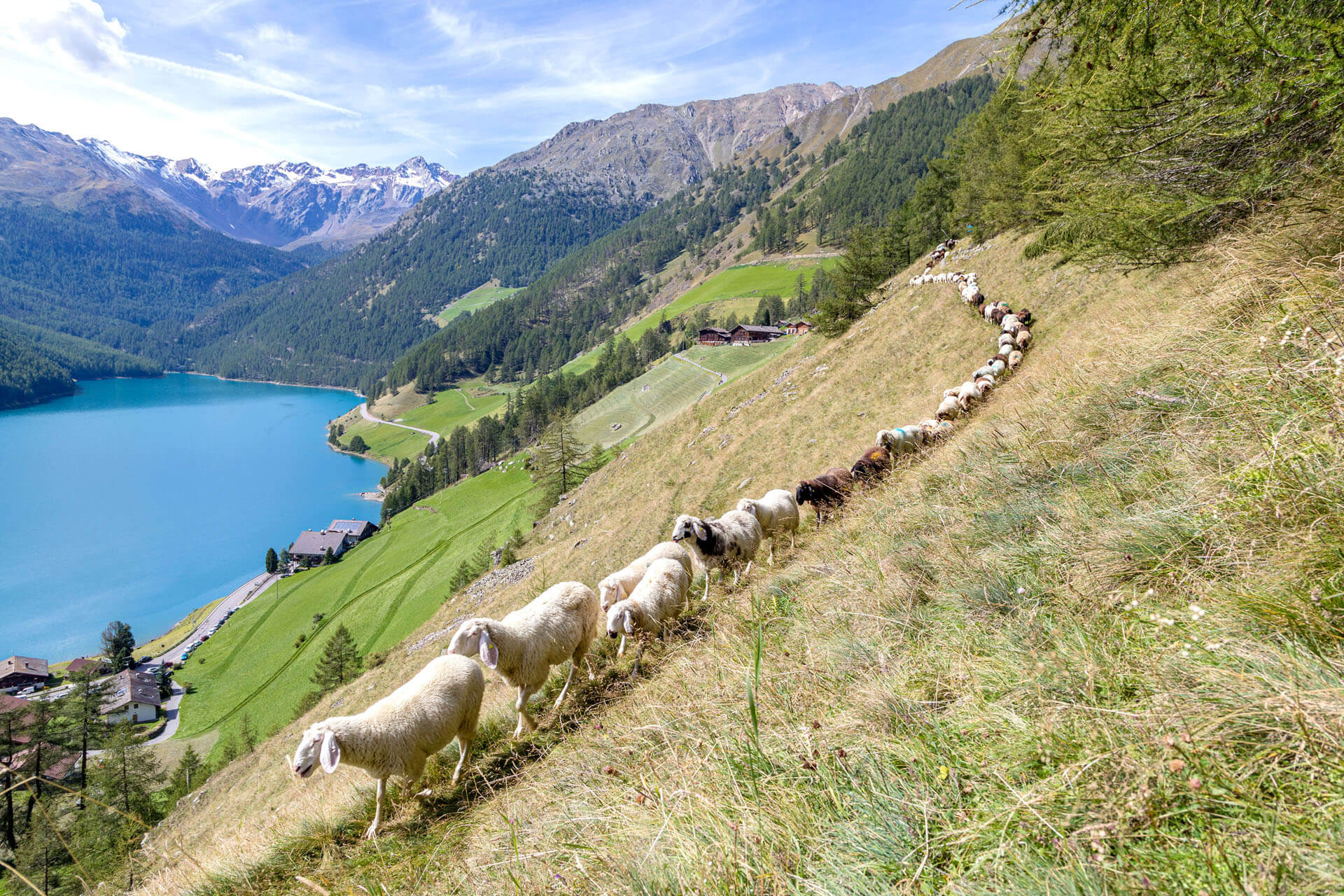
The sheep from the various villages in Val Venosta are joined by the sheep from the farms in Val Senales. There are two places where the flocks meet before crossing the border. The first place is Kurzras at 2,011 m, where the flocks from Schlanders, Kortsch and Sonnenberg arrive and spend the night after crossing the Taschljöchl at 2,772 m before continuing their ascent towards Hochjochferner the next day. Once they arrive at the Schöne Aussicht refuge (at 2,880 m), they take a break, where the shepherds are traditionally offered a barley soup.
Until 1995, before Austria became a member of the European Community, tax officials and veterinarians checked and counted the sheep on “temporary export” here. The route is quite challenging, especially on the Schnalstal side just before the hut. Here it was not uncommon for sheep to slip downhill in icy snow, sometimes with fatal consequences. In recent years, in unfavorable weather conditions, the ascent that runs along the ski slope for a while, then passes below the Austrian Finance Police barracks, which are no longer in use, and ends above Rofen on the pastures at an altitude of around 2,400 m has been preferred.
The second place where the flocks from Val Venosta meet those from Val Senales is located near Lake Vernagt at an altitude of 1,750 meters. The Lasa sheep have already spent the night in the spacious pens. After climbing the Fallerbach valley and passing the Taschljöchl, they set off again to reach the Niederjoch at 3,019 m and the Similaunhütte.
An interesting votive plaque, which is kept in the Church of Our Lady, recalls that an accident occurred here in 1694: “In 1694 I was leading the sheep up the yoke and fell into a crevasse, I called on the Madonna and was saved and I dedicated this plaque to her as a sign of gratitude. Georg Kofler.” But this was neither the first nor the last accident. On June 16, 1979, the initially bad weather quickly turned into a storm. Seven shepherds with 250 sheep were no longer able to continue and asked for help. The innkeeper Leo Gurschler from Kurzras flew the rescuers in with his helicopter at great risk, and they succeeded in rescuing the seven shepherds and 152 sheep. The sheep, which had died in the meantime, were also rescued by helicopter and later brought back to the valley. However, I have found no record of this tragic episode!
From the Similaun hut, the route continues over a section that was covered by a glacier until a few years ago. As already mentioned, before the hut was built, the old route ran further north and higher up to 3,240 m and passed the exact spot where Ötzi was found. The Vent death register records that in 1724 the body of a person who disappeared in the glacier in 1701 was found nearby, described as well preserved but rather crushed. Then there is another historical report: in 1738, the Innsbruck doctor Anton Roschmann climbed through the Niedertal valley into the Schnalstal valley and described his hike in great detail: “… one shivers in an unexpected cold, one sees no trees, no pastures or meadows, but great snow-covered valleys and glaciers, pierced by immense fissures and crevasses, from which grass, stones and even human and animal bones (ossibus hominum, animaliumque) are thrown out…”. Who knows, perhaps shepherds or Ötzi’s companions? Various legends collected and written down before Ötzi was found tell of a hunter who disappeared into the crevasses and inhabited a palace where beautiful virgins lived… But now the glacier has almost disappeared and the beautiful virgins with it.
The descent ends near the hamlet of Kaser, above the village of Vent at an altitude of 2,100 m, where there is a (recently renovated) hut where the shepherd lives throughout the summer. Here, too, there are special rules detailing the relationship between the shepherds from Val Venosta and those from Val d’Ötztal; for example, the sheep from Vent are allowed to drink at a spring on Val Venosta territory, but are not allowed to stay too long (also to avoid consuming too much food), and the agreements stipulate that the shepherds must drive the sheep down after drinking with a loud crack of the whip! I received a lot of information about the Schnals Valley from Konrad, Hermann and Manuel Goetsch, grandfather, father and son respectively: three generations of shepherds that I had the pleasure of getting to know.
By 1963, a third transalpine pass had also been tackled, the Gurglereisjoch, the highest and most dangerous of them all. Like the others, this one is also marked on Peter Anich’s map from 1774, a clear sign of its importance! It is located in the upper Pfossental valley, a side valley of the Schnalstal valley (as the inhabitants of the Schnalstal valley used to say: “Without the Pfossental valley, there is no Schnalstal valley”), where flocks from Naturns and even from the Ultental valley came together alongside the sheep from St. Katharina.
The historian Beda Weber wrote in 1838 that the Pfossental “… is inhabited by 50 people who are housed in nine isolated farms threatened by landslides and avalanches. In the best years, grain cultivation only covers a third of the needs, the rest has to be imported from the Vinschgau Valley…”. The migration of sheep over this pass is not as old as that on the Hochjochferner and Niederjoch, but is only documented from the 17th century onwards. Beda Weber reported in the same year, 1838, that “the owners of the most extreme farms take flocks of 200 or 400 sheep from other valleys into safekeeping for a fee, and thanks to this income they can survive”.
There have been several accidents near this pass, some of which have only been passed down orally, such as the one that is said to have occurred around 1300 and in which eleven shepherds lost their lives. Another serious incident is said to have occurred around 1920, when a violent snowstorm forced the shepherds to seek shelter in the Stettinerhütte at an altitude of 2,875 m on their way back. In this case, the sheep and lambs also came into the building, and those who couldn’t find a place, around 200, froze to death! However, there is a document from another incident that took place on September 10, 1744, which is kept in the archives of St. Catherine’s Church and states: “…rigore necati sunt in monte glaciato…”. It mentions the names of the five deceased shepherds Johannes Gorfer, Josephus Pohl, Georgius Pohl, Casparus Schoepf and Martinus Goetsch and adds that around 100 sheep also perished there!
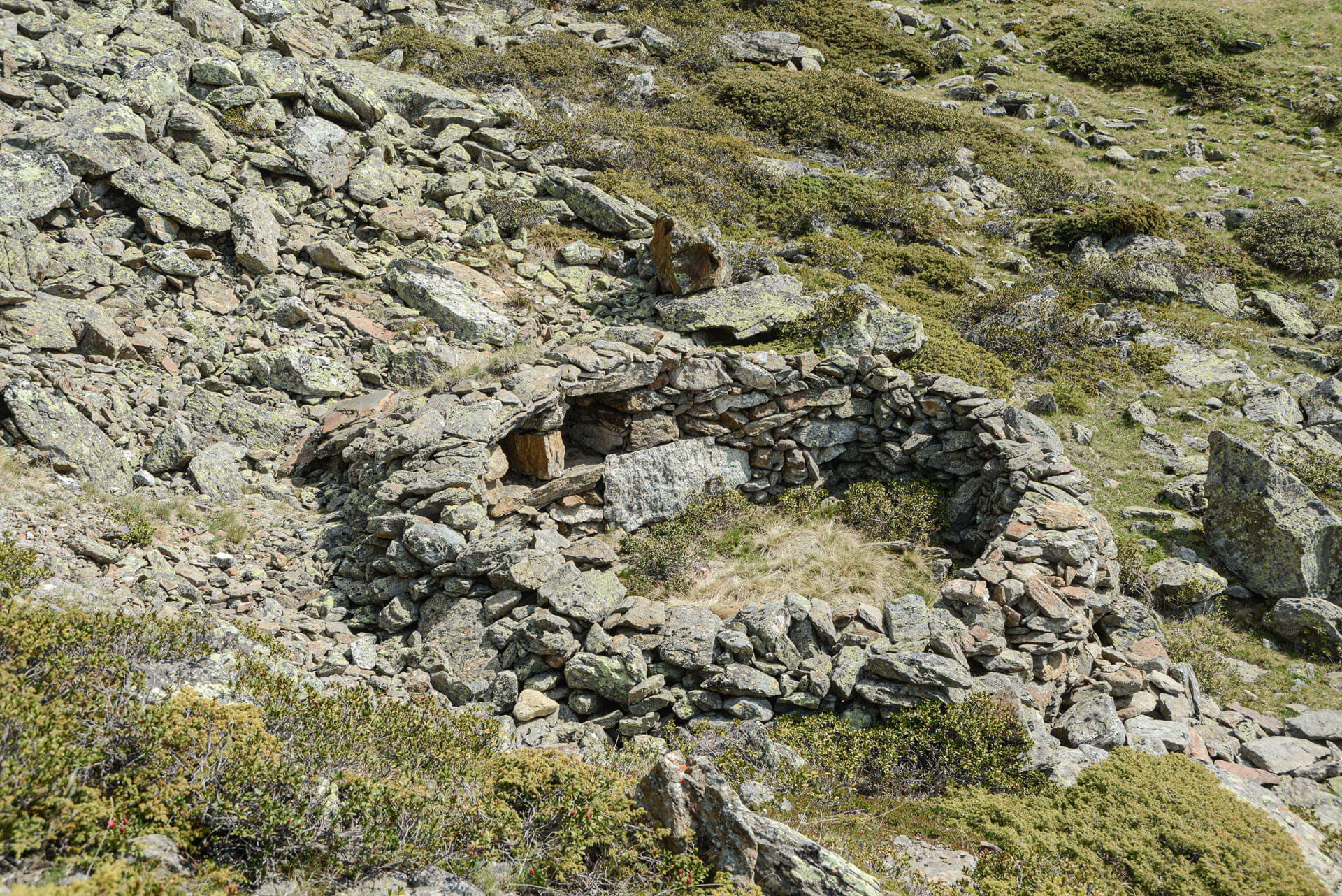
Also in the Pfossental valley, the remains of a fairly large building (approx. 80 m²) were recently discovered at an altitude of around 2,600 m near the path to the Eisjöchl, which archaeologist Andreas Tutzer brought to light in the summer of 2023. There are several fireplaces, niches and structures in the surrounding wall, which indicate that the building was used as an alpine hut. A bronze brooch suggests a date between 1700 and 1400 BC, but the excavations and investigations are still ongoing and could hold even more surprises in store!
From the Pfossental valley, some herds made their way to Pfelders in the Ridnauntal valley, where silver mines were operated for a long time, with up to 1,000 miners working there at peak times. This community had to be supplied with food from lower altitudes, for example from the neighboring Ötztal, Passeiertal and Schnalstal valleys.
With support from the federal government, the state and the European Union






With support from the federal government, the state and the European Union


