

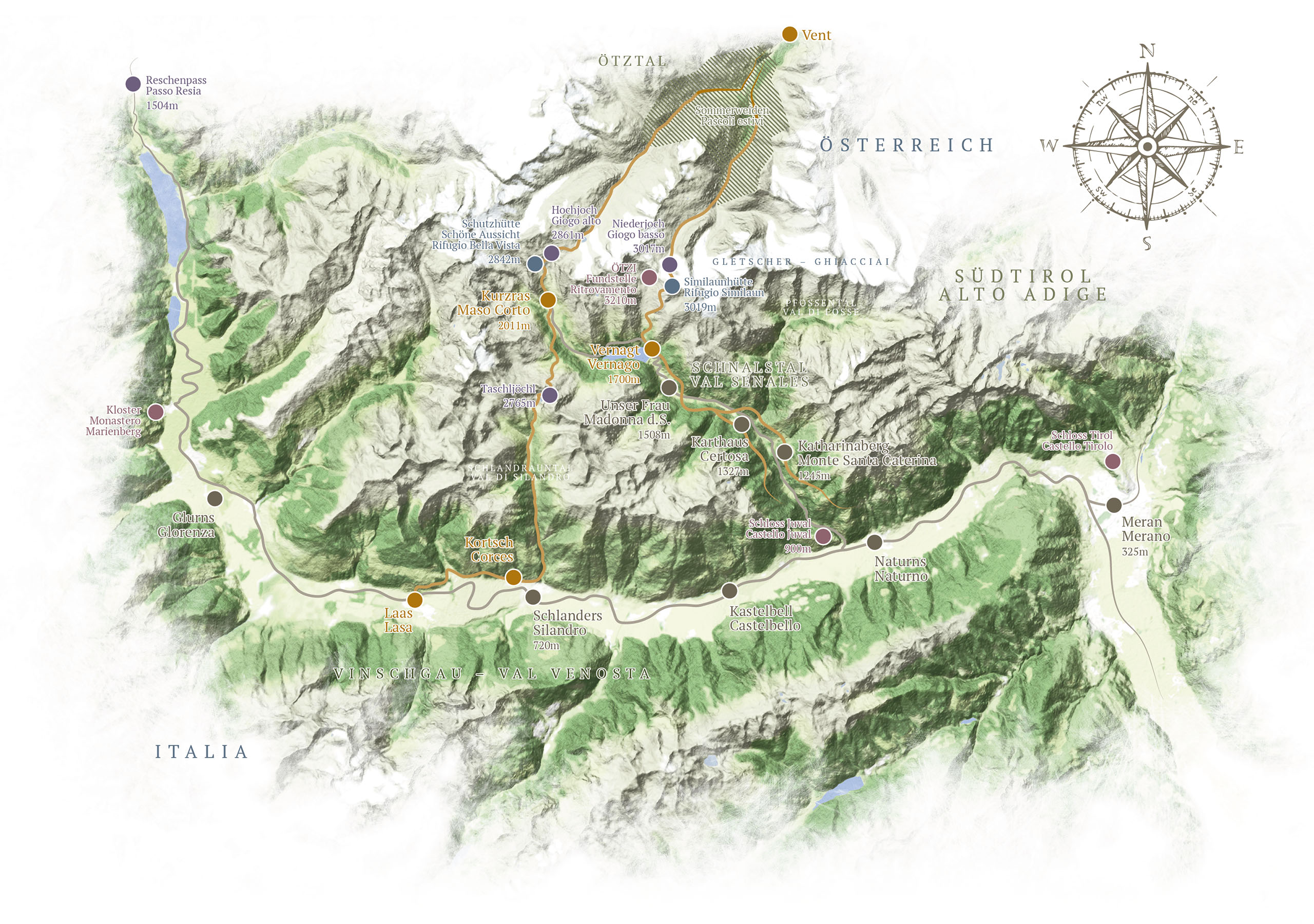
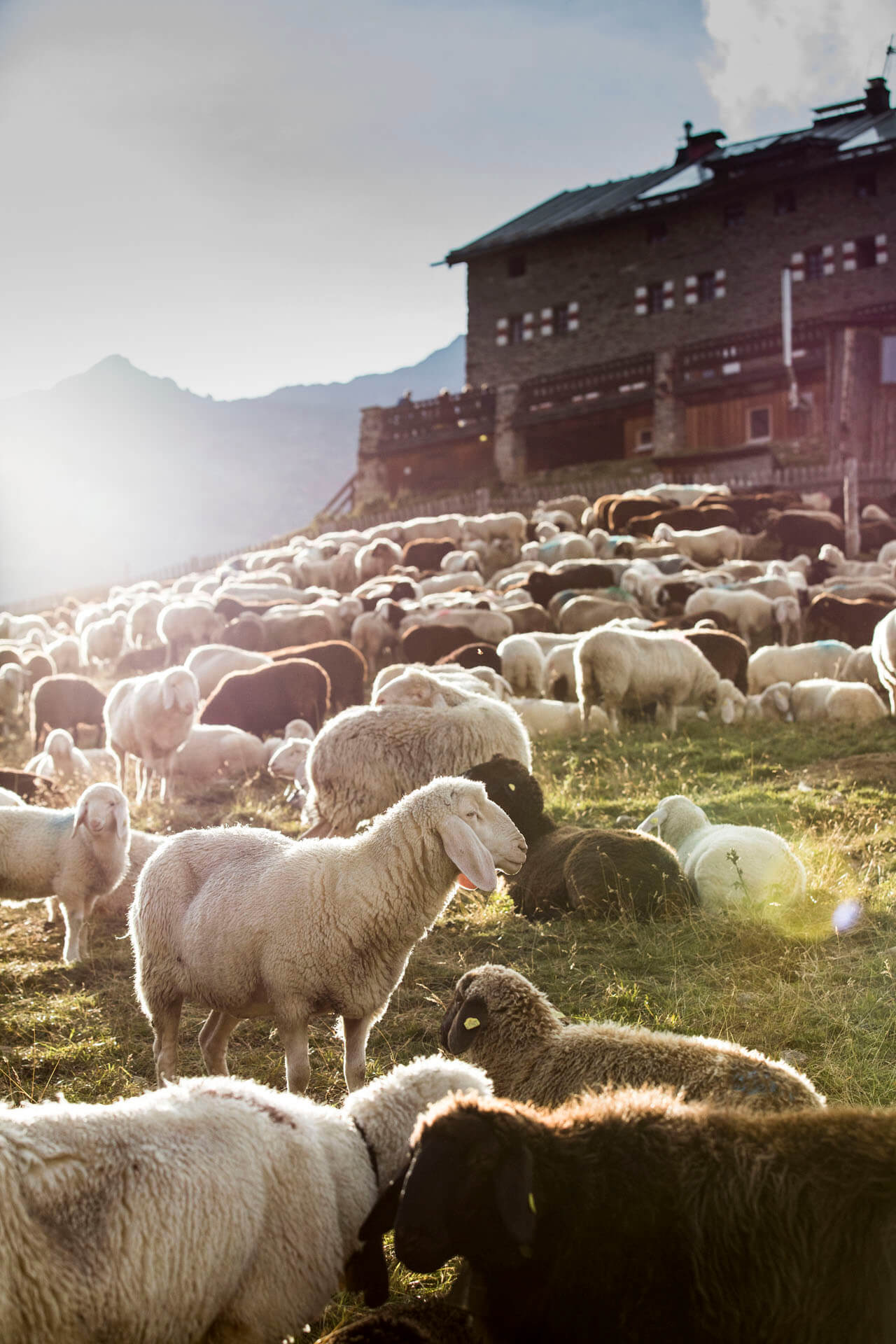
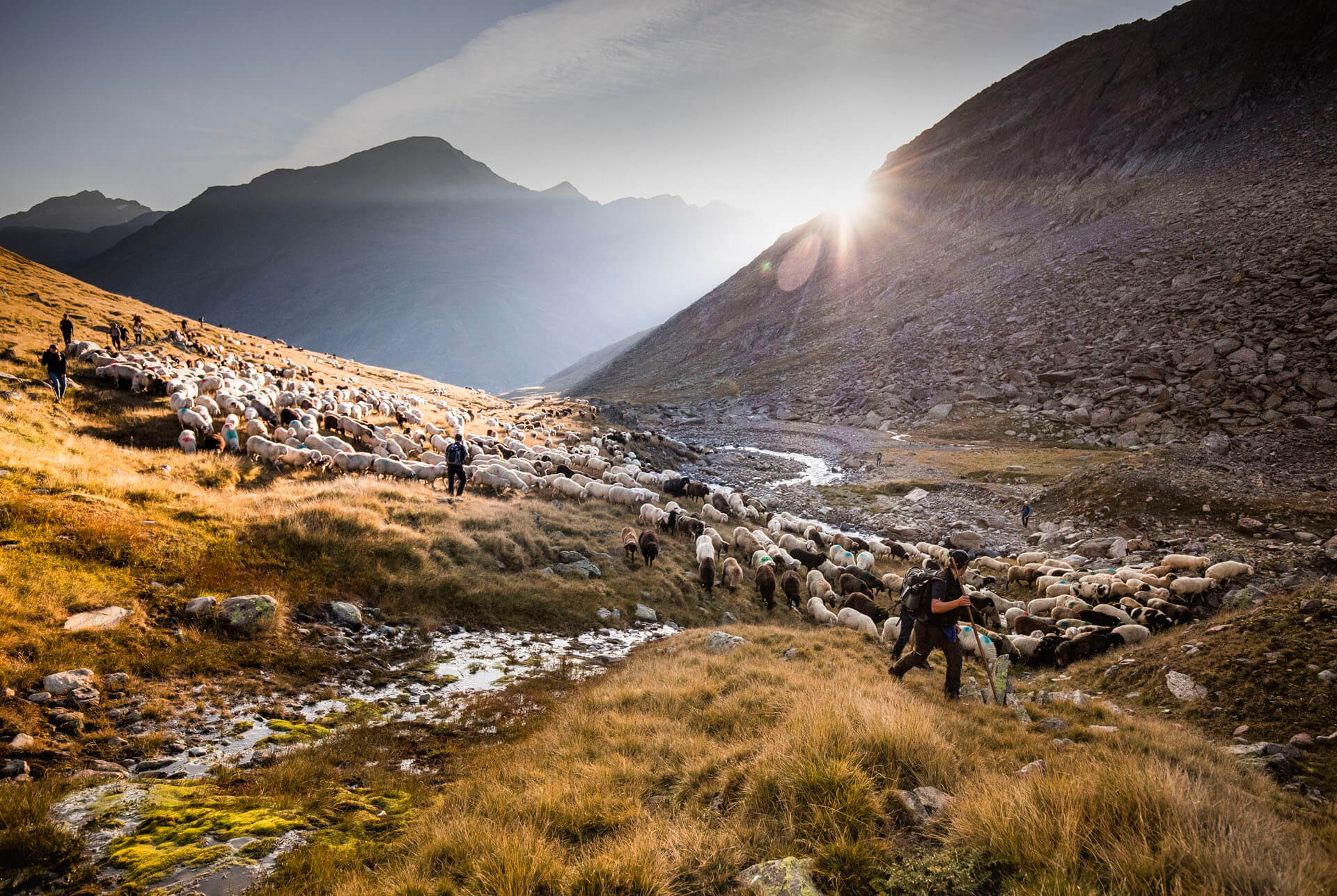
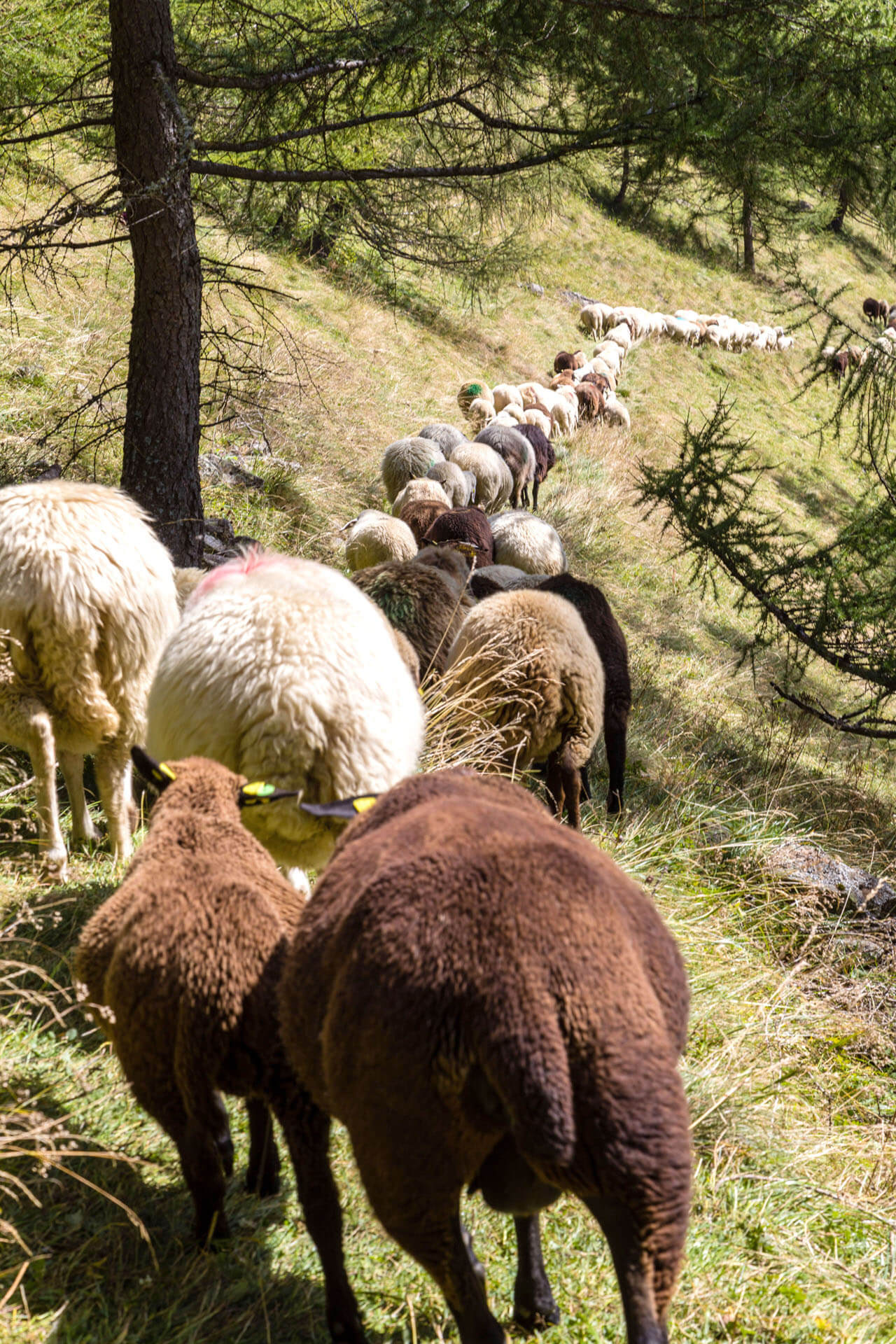
In mid-June, when the mountain pastures on the other side of the main Alpine ridge are free of snow, the ‘long march’ begins for a good quarter of the sheep in Lasa/Laas in Val Venosta/Vinschgau, with over 44 km, 3,200 metres of ascent and 1,800 metres of descent to cover. The sheep now follow the path of the former explorers of the Schnalstal Valley with their shepherds and dogs. ↪Current dates
We spend another night at the assembly points in Kurzras and Vernagt before starting the ascent of the Ötztal main ridge at dawn. There are many snowfields on both the Hochjoch and Niederjoch and steep rock and ice gullies to overcome. On the other side, the high valleys are quite flat, but snowfall, fog and storms can make the descent more difficult.
VERNAGT (1.700 M) – NIEDERJOCH (3.019 M) – NIEDERTALALM
Up to 2,200 sheep and 300 goats start early in the morning between 3:00 am and 6:30 am in four groups in Vernagt and climb up through the Tisental valley, reaching the Similaunhütte on the Niederjoch in around 3 ½ hours. From there, the herd descends towards the Niedertalalm, past the ‘Martin-Busch-Hütte’ (2051m). After approx. 3 hours from the Similaunhütte, the ‘Schäferhütte’ (2,134m) is reached. The Similaun hut and the Martin Busch hut are not yet open on the day of the crossing.
KURZRAS (2.011 M) – HOCHJOCH (2.856 M) – ROFENBERGALM
The first part of the approx. 1,500 sheep starts in Kurzras at around 5.00 am. The sheep and shepherds then reach the Hochjoch in approx. 2 ½ hours. Route length: approx. 5.3 km from Kurzras. After a short rest at the ‘Schöne Aussicht’ refuge, the herd then heads downhill towards the Rofenberg Alm, past the ‘Hochjoch Hospitz’ (2,413m). The descent to the Rofenberg Alm takes a further 2 hours. The Schöne Aussicht refuge is open on the day of the sheep drive. Overnight accommodation at the Hochjoch Hospitz hut is only available on request.
Return in September
Due to the milder climatic conditions, the return journey is usually much easier for humans and animals than the crossing of the main Alpine ridge in spring, which is a huge challenge for both humans and animals. The sheep return to the Schnalstal Valley in mid-September, as they have done for centuries. ↪Current dates
ROFENBERGALM – HOCHJOCH (2.856 M) – KURZRAS (2.011 M)
In the early morning, around 1,500 sheep start at the Rofenberg-Alm in the Venter Valley (A). From there, the trail leads past the Hochjoch Hospitz (refreshment and overnight accommodation), through high alpine terrain (not dangerous), up to the Hochjoch and the Schöne Aussicht refuge (2,845 m), which also offers refreshment and overnight accommodation. The herd arrives there between 11:00 and 12:00. After a short break at the hut, the route descends at a leisurely pace, initially through steep, rocky terrain, then flatter and finally steeper again, to Kurzras, where the herd arrives between 15:00 and 16:00.
NIEDERTALALM – NIEDERJOCH (3.019 M) – VERNAGT (1.700 M)
Up to 2,200 sheep and 300 goats move early in the morning from the ‘Niedertal-Alm’ in the Venter Tal (A), past the Martin Busch Hütte (refreshment and overnight accommodation), through high alpine terrain (not dangerous) up to the Niederjoch (3,019 m) or to the Similaunhütte (refreshment and overnight accommodation), where the first part of the herd arrives at around 9:00 am. Now comes the most dangerous part of the sheep drive, especially when there is already some snow or the path or individual sections of the path are somewhat icy. Below the hut, the train winds downhill on a not too wide path through steep and rocky terrain (down to approx. 2,600 metres). Then it becomes somewhat flatter and less dangerous again. After a rest in the centre of the Tisental valley, the herd descends to Vernagt, where it arrives at around 14:00. Even from a distance you can see a never-ending queue of sheep (approx. ½ hour).
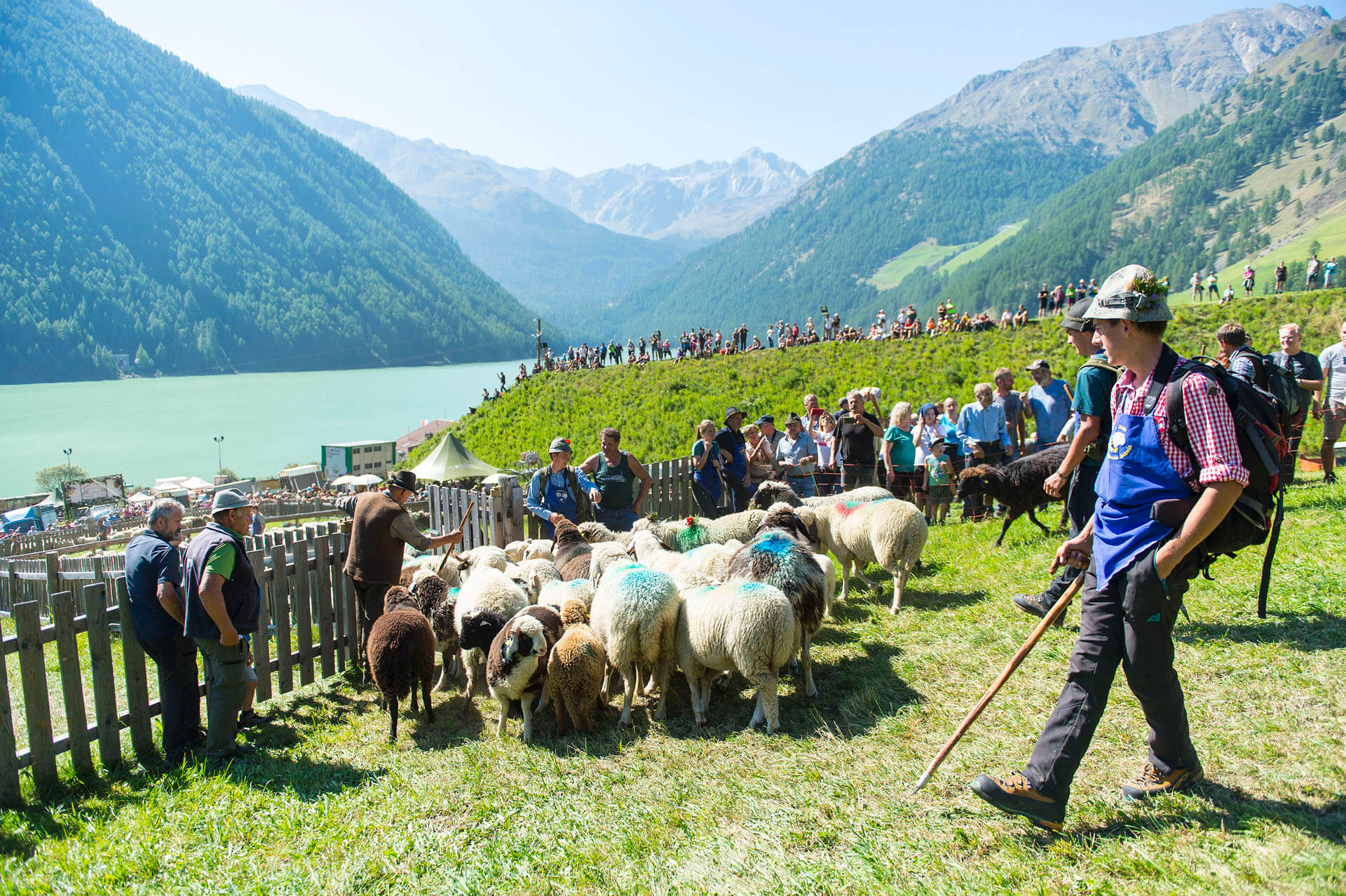
Shepherd’s festivals in the Schnalstal Valley
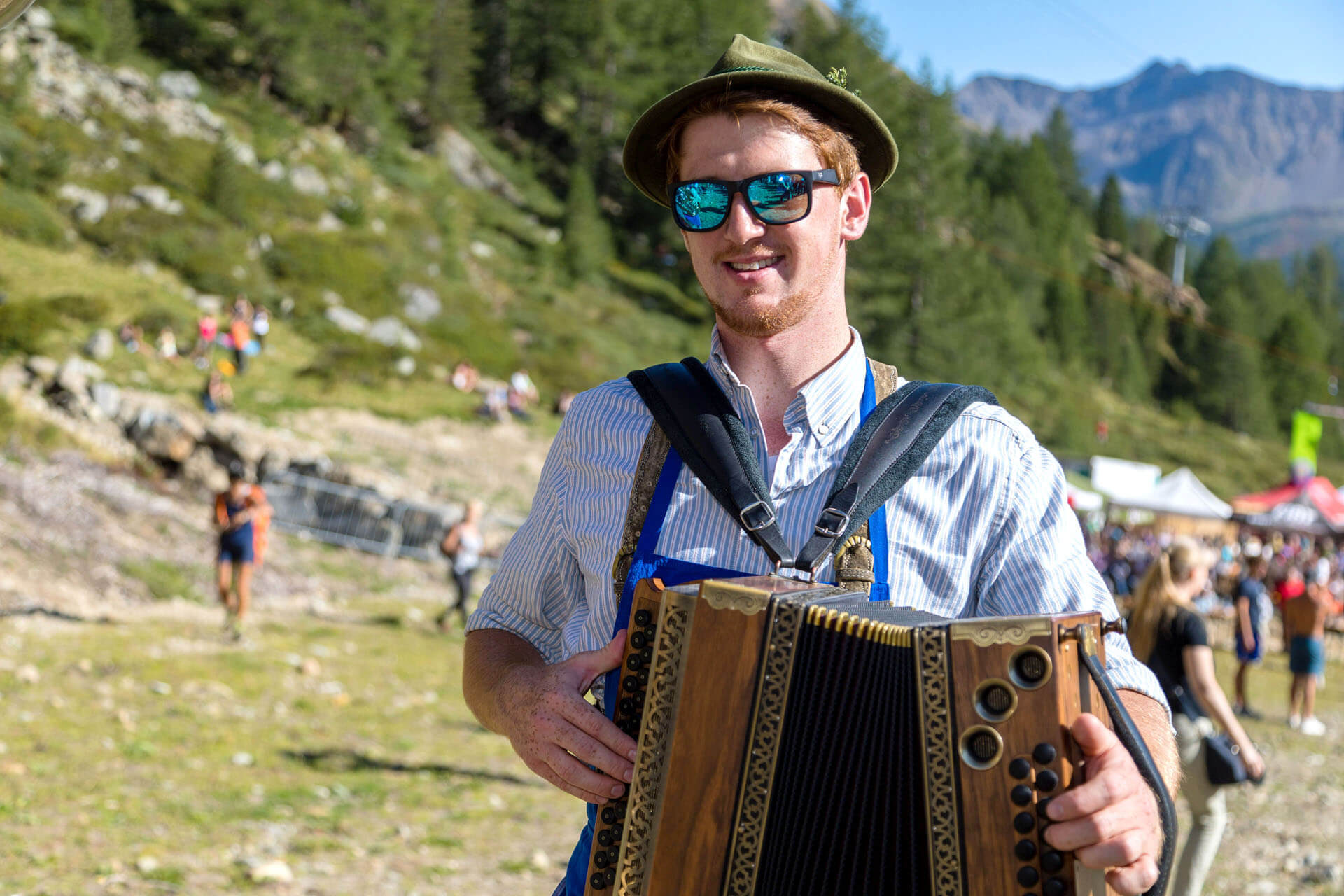
Traditional shepherd festivals in “Kurzras” and “Vernagt” welcome the flocks of sheep and shepherds to the valley. Traditional dishes, drinks and musical entertainment are provided.
With support from the federal government, the state and the European Union






With support from the federal government, the state and the European Union


